Pedestrian access control systems help offices, airports, hospitals, metro stations and commercial facilities manage entry while maintaining an organised flow of people. However, not every entrance can rely on the same type of gate. Standard pedestrian lanes may work well for employees and visitors, while wheelchair users, people with reduced mobility (PRM) and passengers carrying luggage need a wider passage.
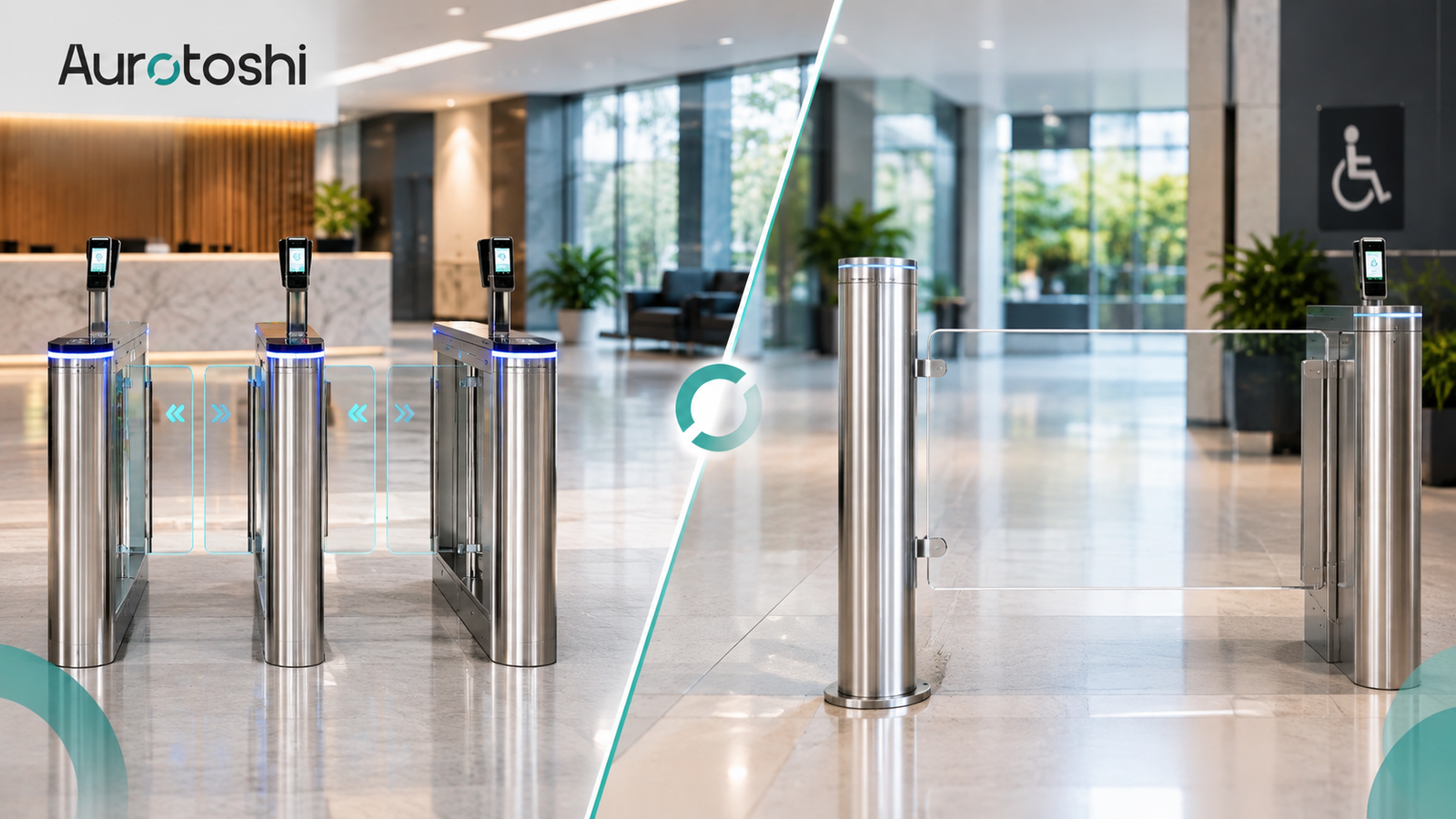
This is where swing barriers and P-gates serve different but complementary purposes. A swing barrier controls regular pedestrian movement through an automated swinging wing, whereas a P-gate provides a wider access lane for users and items that require additional clearance.
Understanding the difference between these gates helps facility managers and project teams select the right configuration based on traffic levels, available space, accessibility requirements and security procedures. These factors are also important when planning an entrance automation system for a commercial or public facility.
What Is a Swing Barrier Gate?
A swing barrier gate is an automatic pedestrian access control system that uses a swinging wing to regulate entry and exit. The wing opens when an authorised credential is accepted and closes after passage, subject to the configured control logic and safety conditions.
Swing barriers are commonly considered for corporate offices, airport terminals, institutional buildings, commercial complexes and other locations where pedestrian movement needs to be controlled without creating a visually obstructive entrance.
Depending on the configuration, a swing barrier can integrate with RFID cards, QR codes, fingerprint readers, facial recognition systems and other compatible access control technologies.
Key Features of Swing Barriers
• Controlled pedestrian entry: Allows authorised users to pass through designated lanes.
• Efficient traffic flow: Suitable for entrances with regular employee, visitor or passenger movement.
• Tailgating detection: Infrared sensors and control logic can help detect unauthorised attempts to follow an authorised user.
• Access control integration: Can work with compatible access credentials and centralised entry management systems.
• Different construction options: Stainless steel cabinets, different wing materials and drive configurations can be selected according to project requirements.
• Emergency operation: Opening behaviour during a fire alarm or power failure depends on the specified configuration and installation.
For facilities comparing models, Aurotoshi offers Economy, Premium and Signature swing barrier configurations. The available options differ in construction, sensing arrangements and drive technology.
When evaluating a Swing Barrier Manufacturer in India, buyers should compare model-specific specifications, passage width, sensor coverage, drive technology, installation requirements and maintenance support before making a decision.
What Is a P-Gate?
A P-gate is a wide-access pedestrian gate designed to accommodate users who cannot comfortably pass through a standard-width turnstile lane. Its P-type arm moves to control access while providing a wider opening for wheelchair users, people with reduced mobility, service trolleys and passengers carrying luggage.
P-gates are commonly installed alongside standard swing barriers or other pedestrian access control lanes. This arrangement allows most users to pass through regular lanes while providing a suitable alternative for people and equipment that require additional space.
The gate can be integrated with compatible access control systems so that wider-lane entry follows the facility's authorisation procedures.
Key Features of P-Gates
• Wider passage: Provides additional clearance for wheelchair users, luggage and trolleys.
• Accessible entrance planning: Helps facilities provide a suitable passage within a controlled entry area.
• Integration with standard lanes: Can operate alongside swing barriers or other pedestrian gates.
• Flexible installation: Cabinet and post configurations suit different spatial and architectural requirements.
• Credential-based access: Compatible access control arrangements can help maintain authorised entry through the wider lane.
• Emergency operation: The required response during a fire alarm or power failure should be confirmed for the selected model and installation.
Aurotoshi offers two P-gate configurations: Cabinet P-Gate (SBPG328) and Post P-Gate (SB318). The cabinet model houses its drive mechanism within a compact enclosure, while the post model uses a column-based arrangement where a smaller physical footprint is preferred.
When shortlisting a P Gate Manufacturer in India, confirm the actual passage clearance, wing configuration, sensor arrangement and compatibility with the site's access control infrastructure.
Swing Barrier vs P-Gate: What Is the Difference?
Although both gates control pedestrian access, their primary purposes differ. A swing barrier generally serves the main pedestrian flow, while a P-gate provides a wider lane for users who need additional clearance.
|
Comparison Factor |
Swing Barrier |
P-Gate |
|
Primary Purpose |
Controls regular pedestrian movement |
Provides wider controlled passage |
|
Typical Users |
Employees, visitors and general pedestrians |
Wheelchair users, PRM users and people with luggage or trolleys |
|
Passage Configuration |
Standard and wide-lane options, depending on model |
Wider-access configuration, depending on model |
|
Typical Placement |
Main entry and exit lanes |
Accessible lane beside standard gates |
|
Access Control |
Integrates with compatible credential systems |
Can integrate with compatible access control systems |
|
Available Configurations |
Economy, Premium and Signature models |
Cabinet and Post models |
|
Selection Priority |
Footfall, lane capacity, security and design |
Accessibility, clearance, layout and controlled access |
The correct choice depends on the entrance layout and its intended users. A swing barrier may be suitable for the majority of pedestrian traffic, but a facility that needs wider access should assess a P-gate or another suitable accessible entrance solution.
When to Choose a P-Gate Instead of a Wide-Lane Swing Barrier
Both gates can offer a wider passage, depending on the model. Aurotoshi's swing barrier range includes a 900 mm wide-lane option alongside the 550 mm standard passage, and its P-gate range lists a 900 mm standard passage. Because the nominal widths are similar, the choice should not rest on width alone. It comes down to how the wider lane will be used, how it must sit within the entrance layout and what the site needs beyond the opening itself.
Choose a wide-lane swing barrier when:
• The wider lane is one of a bank of matching lanes and should look, operate and be serviced like the rest of the entrance, using the same swing barrier model, controller and credential readers.
• Most users of the wide lane are ordinary pedestrians who simply need extra room, for example people carrying bags, and the lane does not need to be set apart as a dedicated accessible route.
• The site wants to stay with one barrier family to keep spares and servicing simple.
Choose a P-gate when:
• The entrance needs a clearly designated accessible lane beside the standard lanes for wheelchair users, people with reduced mobility, luggage and service trolleys.
• The wing opening needs to be specified for the project. The Cabinet P-Gate (SBPG328) has a customisable wing specification, so confirm whether the wide-lane swing barrier offers the same flexibility.
• Floor space is limited. The Post P-Gate (SB318) uses a column-based arrangement for a smaller physical footprint, while the Cabinet P-Gate houses its drive in a compact enclosure.
• Wheelchair or trolley movement is frequent enough that the wider lane should be the obvious, easy-to-approach route rather than one of several similar lanes.
Where requirements are mixed, many entrances use standard swing barriers for the main flow and a P-gate as the dedicated wide lane, instead of widening every lane. Before deciding, ask the manufacturer to confirm the clear opening, operating behaviour and sensor arrangement of both options for your site, because specifications vary by model.
|
Situation |
Wide-Lane Swing Barrier |
P-Gate |
|
Role of the wider lane |
Extra width within a bank of matching lanes |
A dedicated accessible lane beside standard lanes |
|
Typical users |
General pedestrians who need more room |
Wheelchair users, PRM users, luggage and trolleys |
|
Layout |
Same cabinet and appearance as adjacent lanes |
Cabinet (compact enclosure) or Post (smaller footprint) options |
|
Specification flexibility |
Depends on the selected swing barrier model |
Cabinet P-Gate offers a customisable wing specification |
|
Servicing |
One barrier family across all lanes |
A separate gate type alongside the swing barriers |
Can Swing Barriers and P-Gates Be Used Together?
Yes. Combining swing barriers with a P-gate can provide a practical arrangement for entrances that need to manage regular pedestrian traffic while accommodating people who require a wider passage.
For example, a corporate office may use multiple swing barrier lanes for employees and visitors, with a P-gate positioned beside them for wheelchair access, luggage or service trolleys. The gates can be connected to compatible access control infrastructure so that entry permissions follow the facility's security policy.
When planning this arrangement, consider the following factors:
• Lane placement: Position the wider-access lane where it is easy to identify and approach.
• Passage clearance: Confirm the actual usable width after accounting for the wing, cabinet, adjacent barriers and surrounding structures.
• Credential management: Determine whether the same access cards, QR credentials or other approved methods will be used across the lanes.
• Sensor coverage: Check that the selected configuration provides appropriate detection and safe operation for its intended use.
• Emergency planning: Confirm how each gate behaves during a fire alarm, power interruption or evacuation.
• Traffic flow: Assess peak-hour movement and avoid creating queues at the wider-access lane.
The final arrangement should be reviewed against the site's accessibility requirements, applicable building and fire-safety provisions, and the manufacturer's installation instructions.
Where Are Swing Barriers and P-Gates Used?
The suitability of either gate depends on how people enter the building, the items they carry and the level of access control required.
1. Corporate Offices and Business Parks
Swing barriers can help manage employee and visitor entry at reception areas, office towers and business parks. A P-gate can provide a wider passage for wheelchair users, visitors carrying luggage and authorised service movement.
2. Airports and Transportation Facilities
Transport facilities often need to manage passenger movement, luggage and varying accessibility requirements. Swing barriers may be considered for controlled pedestrian routes, while P-gates can support wider access where the layout and security procedures permit.
3. Hospitals and Healthcare Facilities
Hospitals need to consider visitors, staff, wheelchair users and the movement of equipment. Swing barriers may suit designated staff or visitor entrances, while P-gates may be useful at controlled entrances where wider passage is required. Routes used for beds, stretchers or emergency transport require a separate assessment of clearance and operational needs.
4. Metro Stations and Public Transport Hubs
High-footfall transport environments require careful planning around throughput, queuing, accessibility and emergency movement. Swing barriers can manage designated pedestrian flows, while wider gates can accommodate eligible passengers who require additional clearance.
5. Government and Institutional Buildings
Controlled-entry facilities may use swing barriers for routine access and P-gates for wider passage. The selected system should align with the site's access policy, accessibility requirements and security procedures.
6. Industrial and Commercial Facilities
Industrial offices, warehouses and commercial premises may require controlled employee entry alongside movement of authorised trolleys or equipment. Gate selection should account for the actual size and type of items passing through the entrance.
How to Choose the Right Pedestrian Access Control Gate
Before selecting a swing barrier or P-gate, assess the entrance as a complete system rather than comparing the gate price alone.
1. Evaluate Pedestrian Traffic
Estimate average and peak-hour footfall, the direction of movement and the expected queue length. A system suitable for a small office may not be appropriate for a busy transport facility. Compare the manufacturer's rated throughput with expected traffic conditions and the proposed lane arrangement.
2. Confirm Passage Width
Check the clear opening required by the intended users. Do not rely only on the overall dimensions of the gate. The usable passage must accommodate the person or item safely, including any additional clearance required for manoeuvring.
3. Review Access Control Requirements
Determine which credentials the facility uses, such as RFID cards, QR codes or biometric readers. Confirm compatibility with the gate controller, access control software and any existing security infrastructure before finalising the specification.
4. Assess Detection and Safety Features
Review sensor coverage, anti-tailgating functions, obstruction detection and the gate's response to unusual movement. The appropriate configuration depends on the application, risk assessment and manufacturer's documented capabilities.
5. Plan for Emergencies
Confirm what happens during a fire alarm, power failure or emergency release command. Gate behaviour must suit the site's evacuation strategy and applicable safety requirements. Do not assume every model uses the same fail-safe or fail-secure configuration.
6. Consider Construction and Maintenance
Material selection, drive technology, duty cycle, spare-parts availability and maintenance arrangements all influence long-term suitability. Busy entrances may require a different configuration from low-traffic reception areas.
7. Check Installation Space
Allow for the gate cabinet, moving wing, pedestrian approach, accessible route and any nearby doors or walls. A site assessment can help identify layout conflicts before installation.
Why Consider Aurotoshi for Swing Barriers and P-Gates?
Aurotoshi offers pedestrian access control solutions for projects that require controlled entry, different lane configurations and integration with compatible access control systems.
Its swing barrier range includes Economy, Premium and Signature models, while its P-gate range includes Cabinet and Post configurations. These options allow project teams to evaluate the appropriate arrangement based on passage requirements, available space, construction preferences and operational conditions.
Aurotoshi (An Aurionpro Group Company) brings 30+ years of manufacturing experience, three manufacturing units and OEM/ODM capabilities to these projects. When assessing a system, buyers should review the model-specific specifications, approved integrations, emergency behaviour, installation requirements and maintenance support before placing an order.
Frequently Asked Questions
1. What is the difference between a swing barrier and a P-gate?
A swing barrier controls regular pedestrian movement through a swinging wing. A P-gate provides a wider controlled passage for wheelchair users, people with reduced mobility, luggage and trolleys. They can be installed together as part of one pedestrian access control arrangement.
2. Which is better for office entrances, a swing barrier or a P-gate?
A swing barrier is generally suitable for routine employee and visitor entry. A P-gate is useful when the entrance also needs a wider passage. The most suitable arrangement depends on pedestrian volume, accessibility requirements, available space and the site's access policy.
3. What is the standard passage width of a swing barrier?
Aurotoshi's swing barrier range offers a 550 mm standard passage and a 900 mm wide-lane option, depending on the configuration. Confirm the selected model's approved dimensions and actual clear opening before installation.
4. What passage width does a P-gate provide?
Aurotoshi lists a 900 mm standard passage for its P-gate range, with configuration-specific options. The Cabinet P-Gate has a customisable wing specification, while the final clear opening must be confirmed against the selected model and installation layout.
5. Can a P-gate be used for wheelchair access?
A P-gate can provide a wider controlled passage for wheelchair users. However, suitability depends on the actual clear width, approach and turning space, operating force, safety arrangements and applicable accessibility requirements. These should be checked during site planning.
6. Can swing barriers and P-gates use the same access control system?
Yes, they can be integrated into the same access control infrastructure when the selected gate controllers, readers and software are compatible. The system should be configured to apply the appropriate permissions and record entry events according to the site's security policy.
7. Do swing barriers and P-gates prevent tailgating?
Sensors and control logic can detect or help deter tailgating, but performance depends on the gate design, sensor configuration, settings and operating conditions. No gate should be assumed to eliminate every unauthorised entry attempt.
8. What happens to an automatic access control gate during a power failure?
The response depends on the model, controller configuration and emergency arrangements. Some systems may release the passage, while others may require a specified emergency interface or operating procedure. Confirm the documented behaviour for the selected gate before installation.
9. How do I choose a swing barrier manufacturer in India?
Compare the manufacturer's model-specific specifications, construction quality, rated duty cycle, sensing features, access control compatibility, installation support, spare-parts availability and maintenance arrangements. Request technical documentation and confirm that the proposed configuration meets your project requirements.
10. How do I select a P-gate manufacturer in India?
Evaluate passage clearance, cabinet or post design, arm material, drive mechanism, sensor configuration, access control compatibility, emergency operation and after-sales support. Ask for the technical drawing and confirm the usable opening and installation requirements before approving the specification.
11. When should I choose a P-gate instead of a wide-lane swing barrier?
Choose a P-gate when you need a clearly designated accessible lane beside standard lanes, a customisable wing specification, or a smaller footprint through the post configuration. A wide-lane swing barrier suits a bank of matching lanes where the extra width is simply for convenience. Confirm the clear opening and operating behaviour of both options for your site.
Conclusion
Swing barriers and P-gates address different needs within a pedestrian access control system. Swing barriers are suited to managing regular pedestrian traffic, while P-gates provide wider controlled access for wheelchair users, people with reduced mobility, luggage and trolleys.
For many commercial and public facilities, using both types of gates can help balance security, traffic flow and accessibility. The final selection should be based on actual passage requirements, expected footfall, compatible access control technology, emergency operation and the site's layout.
Aurotoshi's swing barrier and P-gate ranges provide configurations that can be assessed against these requirements. Before finalising a system, confirm the technical specifications, site conditions and required access control integrations with the project team.