Fire safety is an essential consideration in the design and operation of commercial buildings, hospitals, factories, warehouses and public infrastructure. While fire detection and suppression systems play an important role, controlling the spread of fire within a building is equally important.
Fire-rated doors help divide buildings into designated fire compartments, restrict the spread of fire for a specified period and protect evacuation routes. For project owners and consultants evaluating Fire Rated Doors Manufacturers in India, understanding fire ratings, door construction, testing standards and hardware is important before finalising a specification.
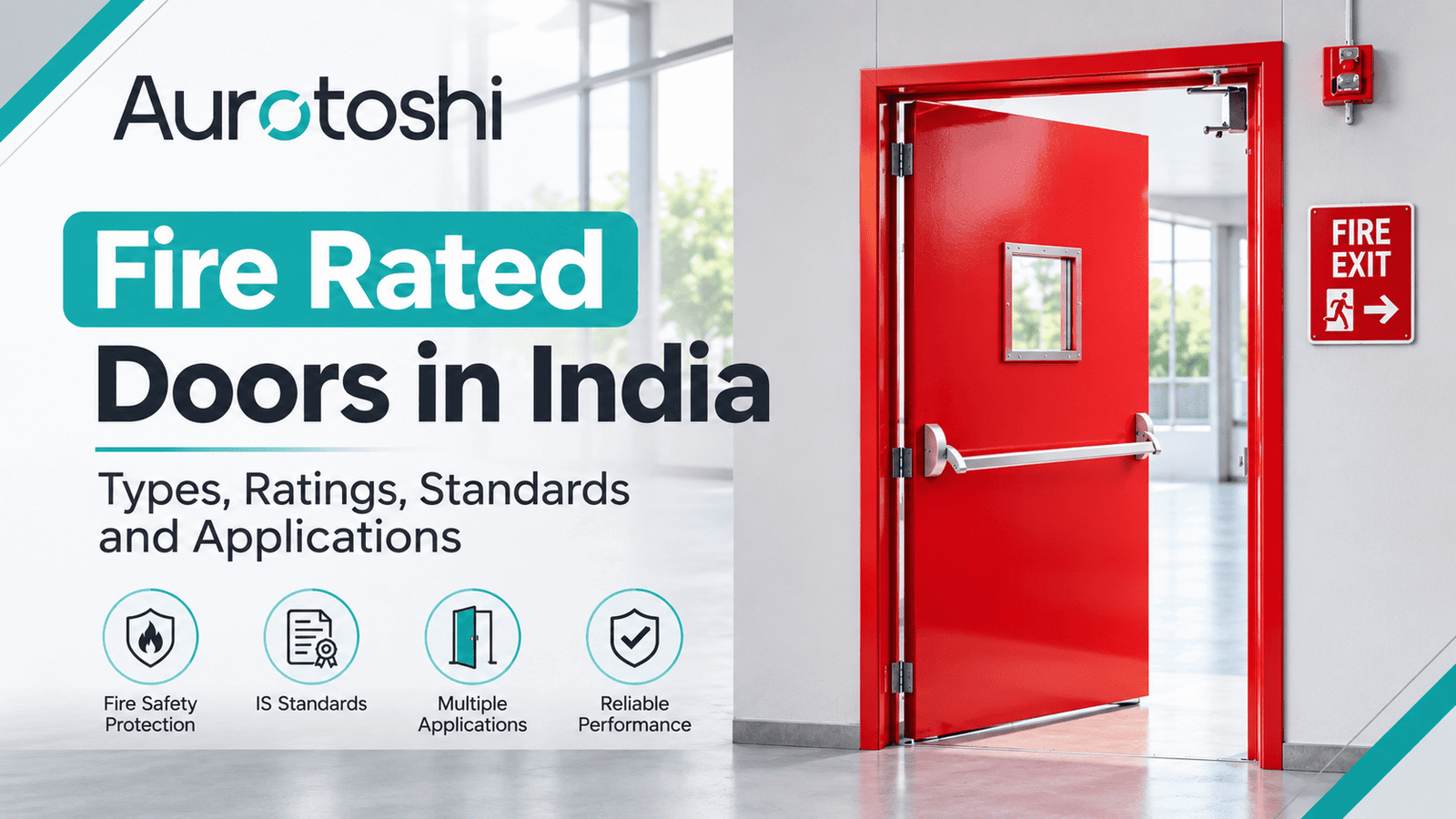
Aurotoshi manufactures 120-minute fire-rated steel door sets designed for industrial and commercial applications. These doors are tested as complete assemblies, with specifications covering the shutter, frame, glazing and hardware.
What Are Fire Rated Doors?
Fire-rated doors are specially designed door assemblies that provide resistance to fire for a specified period under defined testing conditions.
Unlike ordinary doors, a fire-rated door is not evaluated only on the strength or thickness of its shutter. Its performance depends on the complete assembly, including the door leaf, frame, hinges, seals, locking hardware and any vision panel.
The primary purpose is to help maintain fire compartmentation, restrict fire spread and provide occupants with additional time to evacuate.
Types of Fire Rated Doors
Fire-rated doors are available in different materials and configurations depending on the building's requirements.
1. Fire Rated Steel Doors
Steel fire doors are commonly used in factories, warehouses, hospitals, commercial buildings and service areas. Their construction typically includes steel sheets, an appropriate insulation system, reinforced hardware positions and a compatible steel frame.
Aurotoshi offers 120-minute fire-rated steel door assemblies, described in detail below.
2. Fire Rated Wooden Doors
Fire-rated wooden doors are used in certain commercial, institutional and residential building applications. Their construction and performance depend on the tested door assembly and approved hardware.
3. Fire Rated Glass Doors
Fire-rated glass doors and vision panels allow visibility while maintaining specified fire-resistance performance. The glass, glazing system and frame must be part of an appropriately tested assembly.
4. Fire Rated Exit Doors
Fire exit doors are installed along designated evacuation routes. Depending on the application, they may incorporate panic bars, self-closing mechanisms and suitable locking arrangements.
Understanding Fire Door Ratings: 30, 60, 90 and 120 Minutes
Fire ratings indicate the duration for which a tested door assembly meets specified fire-resistance criteria under the applicable test method.
Common classifications include:
• 30-minute fire-rated doors: Used where the approved building design requires a shorter fire-resistance period.
• 60-minute fire-rated doors: Used for designated compartmentation and separation requirements.
• 90-minute fire-rated doors: Specified for certain higher-risk building applications.
• 120-minute fire-rated doors: Provide a two-hour fire-resistance classification under the applicable test criteria.
The required rating should be determined by the building's fire strategy, applicable regulations, occupancy and consultant specifications. A higher rating should not automatically be assumed suitable for every opening.
Fire Door Standards and Testing in India
Fire door selection should be based on recognised testing standards and documentation for the specific assembly.
IS 3614:2021 covers fire doors and doorsets in India. Its Amendment No. 1 introduced changes to requirements and testing references, so project specifications should be checked against the applicable amended standard.
BS 476 Part 22 is another recognised test reference for the fire resistance of non-loadbearing elements of construction.
When evaluating a fire door, buyers and consultants should verify:
• Applicable fire-resistance classification.
• Test reports for the complete door assembly.
• Shutter and frame construction.
• Hardware and glazing details.
• Manufacturer and certification documentation.
• Whether the supplied configuration matches the tested design.
Aurotoshi's specified 120-minute steel door assembly is tested in accordance with IS 3614 Part 2 and BS 476 Part 22, with relevant test documentation available for project verification.
What Makes a 2 Hour Fire Rated Steel Door?
A 2-hour fire-rated steel door requires more than a heavy steel shutter. Its performance depends on the complete construction and compatibility of its components.
Aurotoshi's Auro-TA-FRD120 assembly includes:
• 46 mm shutter thickness: Double-skin, fully flush construction.
• Steel sheets: Two 20-gauge galvanised steel sheets with lock-seam joints.
• Insulation infill: Proprietary infill material within the shutter.
• Hardware reinforcement: Additional steel reinforcement behind hinges, locks and closer positions.
• Steel frame: 16-gauge galvanised steel with a 143 x 57 mm double-rebate profile.
• Intumescent seal: Helps seal gaps during exposure to elevated temperatures.
• Self-closing mechanism: Returns the door to its closed position after use.
• Optional vision panel: 6 mm fire-rated glass measuring 200 x 300 mm, subject to the tested assembly.
The complete specification should be checked against the relevant test documentation before procurement.
Fire Door with Panic Bar vs D-Handle and Lock
The correct hardware configuration depends on where the door is installed and how people need to use it.
|
Feature |
D-Handle and Lock |
Panic Bar |
|
Primary Application |
Rooms, corridors and plant areas |
Emergency exits and stairways |
|
Operation |
Handle and locking mechanism |
Push-bar release |
|
Main Purpose |
Controlled access |
Quick escape-side release |
|
Configuration |
Single or double leaf |
Single or double leaf |
Both configurations can carry the same fire rating when supplied as part of the appropriately tested assembly. The choice should follow the building's escape strategy and applicable hardware requirements.
Where Are Fire Rated Doors Used?
Fire-rated doors are installed in buildings where fire compartmentation and protected circulation are important.
Hospitals: Used in designated fire compartments, service areas and protected corridors.
Factories and manufacturing plants: Help separate production areas, electrical rooms, utility spaces and other designated fire zones.
Warehouses and logistics centres: Support compartmentation between storage, operational and service areas.
Commercial buildings: Used in stairwells, corridors, plant rooms and designated fire exits.
Pharmaceutical facilities: Help maintain fire separation between designated production and service spaces.
Data centres: Used where the building's fire strategy requires separation of technical, electrical and equipment areas.
How to Choose the Right Fire Rated Door for Your Building
Before selecting a fire door, evaluate the following requirements:
• Required fire rating: Confirm the rating specified in the approved fire-safety design.
• Opening dimensions: Check whether a single-leaf or double-leaf configuration is required.
• Door hardware: Select a suitable locking arrangement or panic bar based on the opening's purpose.
• Frame construction: Ensure that the frame matches the tested assembly.
• Vision panel: Specify fire-rated glazing only where the tested design permits it.
• Self-closing mechanism: Confirm that the door closes reliably without obstruction.
• Documentation: Request relevant test reports and certification records.
• Installation and maintenance: Ensure proper anchoring, alignment, inspection and servicing.
The table below turns these points into a starting recommendation for common openings. The approved fire-safety design still decides the final rating and hardware.
|
Opening |
Usually the Right Configuration |
Check |
|
Plant room, utility room or service corridor |
D-handle and mortice lock, single leaf |
Lock and closer match the tested assembly |
|
Stairwell or emergency exit route |
Panic bar, single or double leaf |
Escape-side release and self-closing action |
|
Wide opening for equipment or trolleys |
Double leaf |
Frame and leaf sizes are within the tested design |
|
Opening where visibility is needed |
Door with fire-rated vision panel |
Glass size and glazing are covered by the test |
Why Choose Aurotoshi for Fire Rated Doors?
Aurotoshi (An Aurionpro Group Company) manufactures 120-minute fire-rated steel door sets for industrial and commercial building requirements, backed by 30+ years of manufacturing experience, three manufacturing units and OEM/ODM capabilities.
Its Auro-TA-FRD120 range includes D-handle and mortice lock configurations as well as panic-bar options, available in single-leaf and double-leaf arrangements.
As an established entrance automation company in India, Aurotoshi brings manufacturing, engineering, installation and after-sales support capabilities to industrial and infrastructure projects.
The company also provides maintenance support covering hinges, door closers, panic bars, locks, intumescent seals and frame inspections. This helps building operators maintain door functionality and keep service records for safety reviews.
Frequently Asked Questions
1. What are fire rated doors?
Fire-rated doors are specially designed door assemblies that resist fire for a specified period under defined testing conditions. They help restrict fire spread and support safe evacuation.
2. What are the different fire door ratings?
Common fire-resistance classifications include 30, 60, 90 and 120 minutes. The required classification depends on the building's fire strategy and applicable regulations.
3. What is a 2 hour fire rated door?
A 2-hour fire-rated door is a tested assembly classified for 120 minutes under the applicable fire-resistance test criteria.
4. Which standard applies to fire rated doors in India?
IS 3614:2021, including its applicable amendment, covers fire doors and doorsets in India. The project specification and test documentation should identify the relevant requirements.
5. What is the difference between a fire door and a normal steel door?
A fire-rated door is tested as a complete assembly for specified fire-resistance performance. An ordinary steel door does not automatically provide an equivalent level of fire protection.
6. Can fire rated doors have glass panels?
Yes. Fire-rated glass vision panels can be incorporated when the glazing size, glass and installation details are covered by the tested assembly.
7. Should I choose a panic bar or a D-handle for a fire door?
A panic bar is generally specified for emergency escape routes requiring quick release from the escape side. A D-handle and mortice lock are suitable for certain controlled-access openings, subject to the fire and egress design.
8. Are fire rated doors required to have self-closing mechanisms?
Where required by the approved fire-door design, a compatible self-closing mechanism ensures that the door returns to its closed position after use.
9. Where are 120-minute fire rated doors used?
They may be specified in factories, warehouses, hospitals, commercial buildings, service areas and other locations where the approved fire strategy requires a 120-minute door assembly.
10. What maintenance do fire rated doors require?
Maintenance includes inspecting hinges, closers, locks, panic bars, seals, vision panels, frames and anchors. Damaged or incompatible components should be repaired or replaced with approved components.
11. How can I verify whether a fire rated door is certified?
Request the relevant test report and certification documentation. Check that the supplied shutter, frame, hardware and glazing match the tested configuration.
12. Does Aurotoshi manufacture 2-hour fire rated steel doors?
Yes. Aurotoshi manufactures 120-minute steel fire door sets in D-handle and lock as well as panic-bar configurations, with single-leaf and double-leaf options.