Introduction
Pedestrian entrances in corporate lobbies, airports, hospitals and metro concourses have to do two jobs at once: control who gets in and keep people moving. A swing barrier does both with a wing that swings clear of the passage instead of retracting into the cabinet, which gives a wider opening within the same footprint. If you are comparing options from a Swing Barrier Manufacturer in India, the real questions are which build tier suits the entrance, how wide the lane needs to be and how the barrier behaves in an emergency.
This guide explains how swing barrier gates work, the three models available, where each fits, how they compare with other pedestrian gates, what drives the cost and how to choose one for your site.
What Is a Swing Barrier Gate?
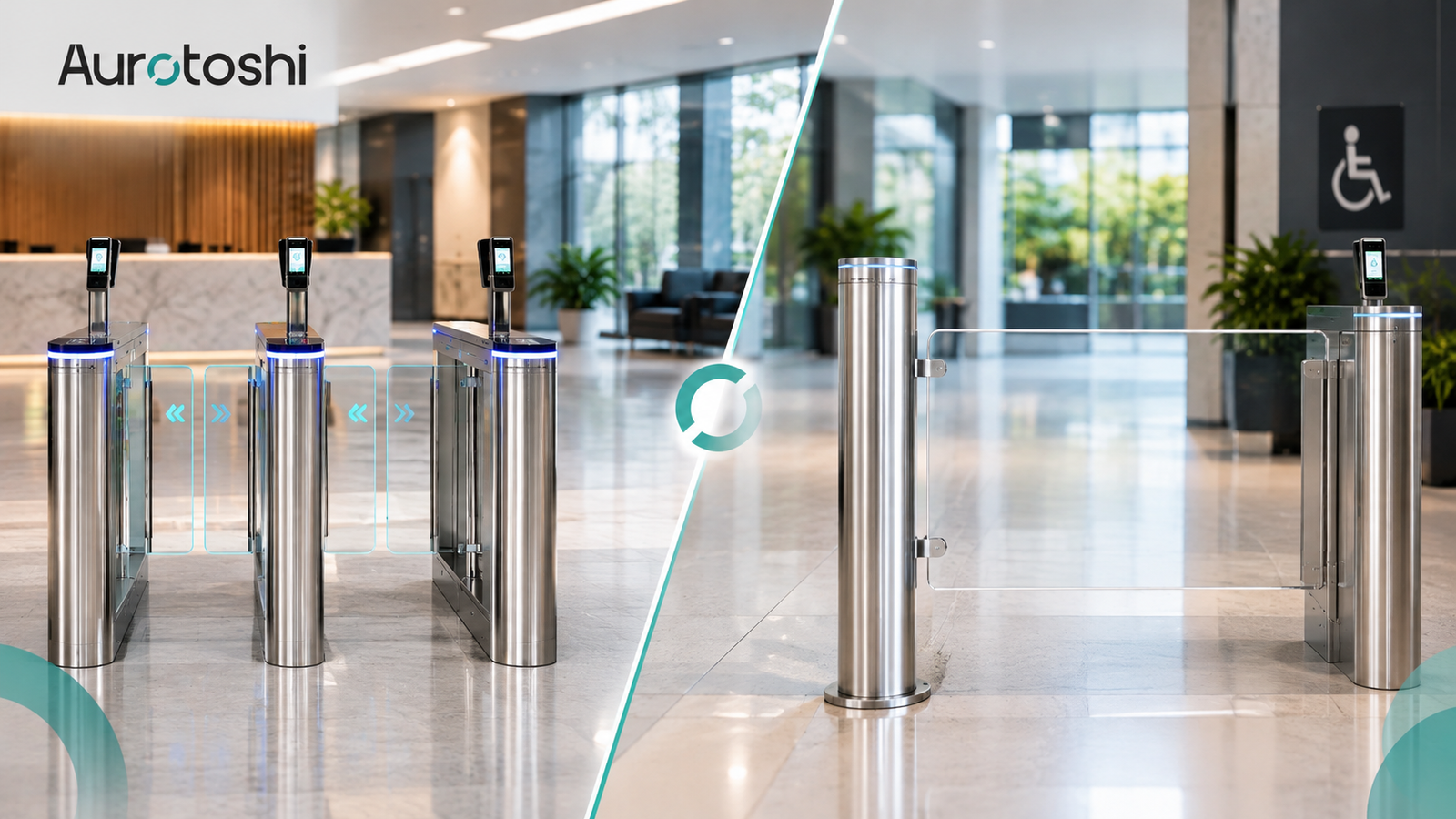
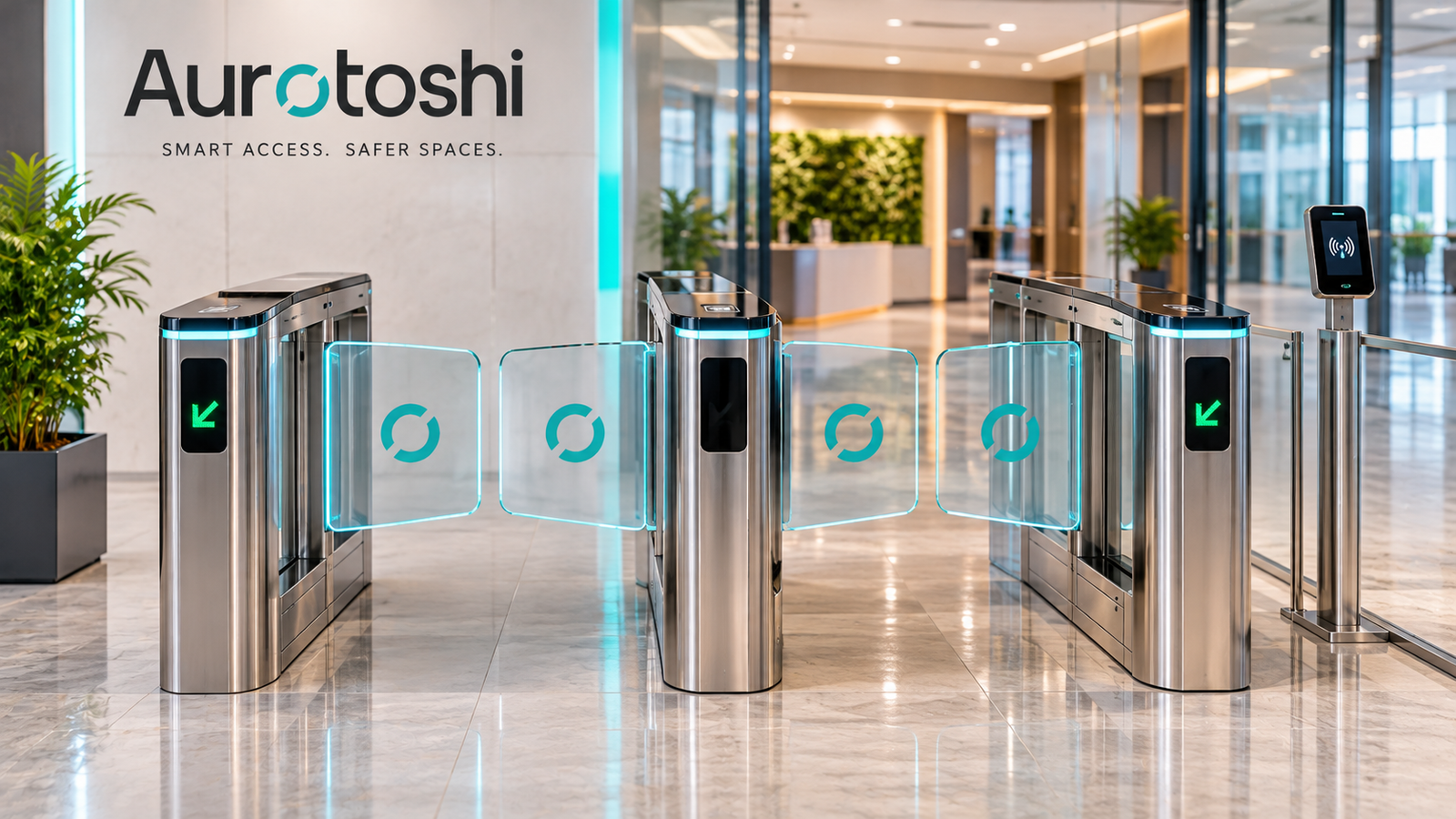
A swing barrier gate is an automatic pedestrian access control lane. After a valid credential is read, a wing swings clear of the passage to let one person through, then closes. Because the wing swings away rather than sliding into the cabinet, the same footprint can offer a wide opening, which suits briefcases, suitcases and wheelchair users without needing a separate accessible gate alongside.
Aurotoshi's swing barriers are offered with a 550 mm standard passage or a 900 mm wide lane for persons with reduced mobility (PRM), and are rated for 30 to 35 persons per minute per lane. They are specified where an entrance is both an access control point and a public-facing space, such as corporate lobbies, airports, metro concourses, hospitals, government buildings and institutional receptions.
How Does a Swing Barrier Work?
The operating sequence is short, but each step matters for both flow and security:
• A person presents a credential, such as an RFID card, QR code, fingerprint or face.
• The access control system verifies the credential and signals the gate control unit.
• The wing swings clear of the passage.
• Infrared sensors watch the lane while the person passes, helping detect tailgating and piggybacking.
• The wing closes once the passage is complete.
Aurotoshi lanes use an Aurotoshi gate control unit with its own firmware, which coordinates the sensors, runs the anti-tailgating logic and handles the fail-safe release. On a fire alarm or power loss, the wings open automatically to clear the lane. As with any installation, the fire alarm interface should be confirmed and tested during commissioning.
Swing Barrier Models: Economy, Premium and Signature
All three tiers share the same lane concept, with standard and wide passages, anti-tailgating and anti-pass-back logic and CE certification. They differ in construction, sensing and drive technology, and the right tier depends on the character and workload of the entrance.
1. Economy (SB3216)
The Economy model is the practical choice for routine staff or visitor lanes where budget leads the decision. It combines a slim stainless steel cabinet with an illuminated wing and a brushless DC drive, and it is the lightest of the three.
Key specifications:
• Model code: Auro-TA-SB3216-S / -D
• Dimensions: 1400 x 160 x 980 mm (plus or minus 5%)
• Cabinet: 1.2 mm SS 304 hairline, SS 316 or powder-coated steel
• Wing: 10 mm clear acrylic or polycarbonate with blue and green illumination
• Weight: approximately 45 kg
• Power: standby 20 W, operating 50 W, 110 to 220 V AC
• Protection and temperature: IP 44, -10 to 55 degrees C
• Maintenance: MTTR under 30 minutes
2. Premium (SB306)
The Premium model suits main lobbies and sustained footfall across a bank of lanes. It uses a heavier stainless steel construction and lets you specify the wing, including glass or a custom thickness, which matters where the barrier is part of the entrance design.
3. Signature (SB3217)
The Signature model is the flagship for landmark lobbies and the busiest entrances. Its cabinet is 3 mm forged aluminium alloy, anodised and without welded joints, and it runs a servo drive whose opening time can be tuned to the pace of the crowd. Multiple anodised colour options are available.
Economy vs Premium vs Signature at a Glance
|
Specification |
Economy |
Premium |
Signature |
|
Choose It When |
Budget leads and the lane is a routine staff or visitor entry |
The lane is a main entrance and you want to specify the wing |
The entrance is a statement piece and the lane runs hard all day |
|
Traffic Profile |
Steady daily footfall, one or two lanes |
Sustained footfall across a bank of lanes |
Peak-hour surges and continuous duty |
|
Entrance Character |
Functional, with the smallest floor presence |
Considered, with a heavier stainless section |
Architectural, with a forged aluminium cabinet |
|
IR Sensor Pairs |
6 |
5 |
8 |
|
Opening Time |
Fixed, under 0.5 second |
Fixed, under 0.5 second |
Adjustable, 0.5 to 1.5 seconds |
|
Service Life |
10 million cycles |
10 million cycles |
15 million cycles |
More sensor pairs give finer detection across the lane, which is why the busiest or most security-sensitive entrances tend to move up a tier.
Which Swing Barrier Suits Which Entrance?
The three tiers and two passage widths can be combined in several ways. This table shows the setup that usually fits each common entrance, so you can start from your situation rather than from the model list.
|
Your Entrance |
Usually the Right Setup |
Why |
|
Staff entry with steady footfall and one or two lanes |
Economy with a 550 mm lane |
Covers routine duty without paying for a heavier build |
|
Main lobby with a bank of lanes and visitors carrying bags |
Premium, with a mix of 550 mm and 900 mm lanes |
The wing can be specified to suit the interior, and wide lanes handle luggage |
|
Airport or landmark lobby with peak-hour surges |
Signature, with 900 mm lanes where needed |
Servo drive with tunable opening time and the longest service life |
|
Hospital entrance used by wheelchair users and visitors with equipment |
A 900 mm wide lane on any tier, plus a P-gate if a dedicated accessible lane is wanted |
Keeps the main lane usable for everyone while the P-gate marks the accessible route |
|
Shared lobby with many visitors and a higher tailgating risk |
A higher tier for more sensor pairs, backed by entrance procedures |
Finer detection across the lane, but no gate replaces sensible procedures |
|
Building that already runs a biometric or card system |
Any tier, after confirming reader compatibility |
The credential system should drive the choice of reader, not the other way round |
Where two rows apply to the same entrance, choose for the harder one. A lobby that is both a hospital entrance and a peak-hour surge point, for example, should be specified for the surge and given wide lanes.
Swing Barrier vs Other Pedestrian Gates
Swing barriers sit alongside several other pedestrian lane types. The differences are in how the barrier moves and how wide the lane can be.
|
Gate Type |
How It Works |
Passage |
Best For |
|
Swing Barrier |
A wing swings clear of the passage |
550 mm standard, 900 mm wide lane |
Lobbies, airports and hospitals where luggage and wheelchair users share the lane |
|
Flap Barrier |
Wings retract into the cabinet |
550 mm standard, with a 900 mm option on the FB242 |
High-footfall staff lanes where speed matters most |
|
Tripod Turnstile |
Three rotating arms at waist height |
550 mm |
Compact managed flow in offices and plants |
|
P-Gate |
A P-type arm on a dedicated wide lane |
900 mm |
An accessible lane beside standard lanes |
Choose a swing barrier when one lane has to serve everyone, including people with luggage and PRM users. A flap barrier suits high-volume staff entry where a narrower lane is acceptable and every second counts. If you want a separate, clearly marked accessible lane beside a bank of standard lanes, a P-gate is the better fit.
Where Are Swing Barriers Used?
Corporate Lobbies and Business Parks
Reception lobbies serve employees, visitors and couriers at once. A swing barrier keeps staff moving while giving visitors with bags and wheelchair users enough room.
Airports
Airport concourses and staff entrances see passengers with luggage, so a wide lane from the same footprint helps keep flow smooth without a separate gate.
Metro Concourses
Swing barriers can manage controlled pedestrian routes in metro concourses. Where ticket validation and fare calculation are needed, a dedicated fare collection gate is still the right tool.
Hospitals
Hospitals need wide passages for wheelchairs and visitors with equipment. Routes used for beds or stretchers still need their own clearance assessment.
Government and Institutional Buildings
Reception areas and controlled entrances in government and institutional buildings often combine access control with a public-facing appearance, which is where swing barriers are commonly specified.
How to Choose the Right Swing Barrier
Start with the entrance, not the model.
1. Estimate Peak Footfall
Use the peak arrival period rather than a daily average. Divide expected peak-hour movement by the per-lane throughput of the gate, then add a margin for how people actually queue and for the entry and exit split.
2. Decide the Passage Width
A 550 mm standard lane suits general staff entry. Choose the 900 mm wide lane where luggage, trolleys or PRM users will use the same lane. If you want a dedicated accessible lane beside the standard lanes, consider a P-gate instead.
3. Match the Tier to the Entrance
Economy suits routine lanes, Premium suits main lobbies and banks of lanes, and Signature suits landmark entrances and continuous duty. Choosing a tier above what the entrance needs adds cost, and choosing below it shows up as wear and complaints during peak hours.
4. Check Sensing and Security Needs
Higher tailgating risk, such as a shared lobby with many visitors, justifies more sensor pairs and a tier that offers them. Low-risk staff lanes can use the standard sensing arrangement.
5. Confirm Access Control Compatibility
List the readers and software already in the building and confirm they are supported before the specification is frozen. Changing credential type later is more expensive than choosing correctly at the start.
6. Verify Emergency Behaviour
Confirm how the lane behaves on a fire alarm and a power failure, connect it to the building's fire alarm system and test the release during commissioning.
7. Plan Space, Service and AMC
Check the cabinet footprint against the entrance, and plan service from day one. Aurotoshi offers quarterly AMC covering drive and wing servicing, sensor alignment, reader calibration and fail-safe testing, 24-hour breakdown response for AMC customers, and spares dispatched from its Ghaziabad facility, with engineers across Delhi NCR, Mumbai and Pune.
What Affects Swing Barrier Price in India?
Swing barrier price depends on the configuration more than on the gate type. The main factors are:
• The tier chosen: Economy, Premium or Signature
• Cabinet material and finish, such as SS 304, SS 316, powder-coated steel or forged aluminium
• Wing material and thickness, including illumination or a custom wing
• Standard or wide passage
• Number of lanes
• Access control readers and integration
• Installation conditions and site works
• AMC and service requirements
Because these factors change from site to site, a quote based on the entrance layout and credential system is more reliable than a standard price list.
Installation, Maintenance and Service
A swing barrier runs every working day, so service planning matters as much as the specification. Preventive maintenance should cover the drive and wing mechanism, infrared sensor alignment, reader calibration and a test of the fail-safe release. Keeping service records also helps when the building is audited.
Check that spares are held by the manufacturer rather than sourced from third parties, because a lane that is out of service at a busy lobby is noticed immediately.
Why Choose Aurotoshi Swing Barriers?
Aurotoshi designs and manufactures swing barrier cabinets, wings and drive assemblies in-house at its manufacturing facility in the Bulandshahar Road Industrial Area, Ghaziabad, and fits each lane with its own gate control unit and firmware. Because the hardware, firmware and spares come from the same manufacturer, specification questions, site changes and replacement parts are handled by one team.
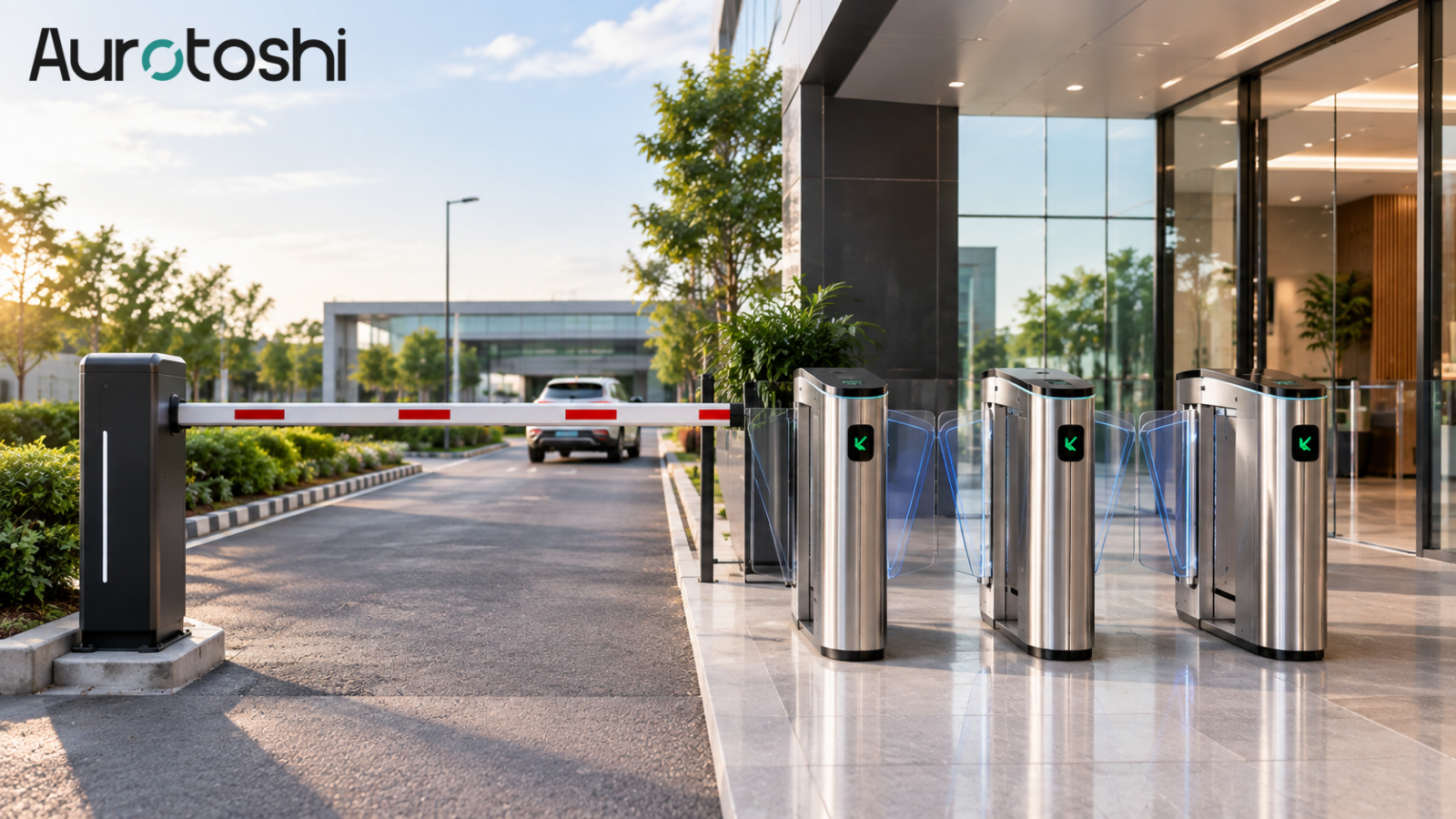
Aurotoshi (An Aurionpro Group Company) brings 30+ years of manufacturing experience, three manufacturing units and OEM/ODM capabilities to these ranges. Swing barriers can also be combined with the company's wider entrance automation systems where pedestrian and vehicle entrances need to be planned together.
For a buyer, the capabilities behind the barrier matter as much as the barrier itself:
• In-house design and manufacturing, so the specification can follow the entrance instead of forcing the entrance into a catalogue model.
• Build choices across three tiers, stainless steel or forged aluminium cabinets and different wing options.
• Support for the credentials a building already uses, including RFID, fingerprint, QR, face, iris and Morpho readers.
• Structured service, with AMC, 24-hour breakdown response for AMC customers, manufacturer-held spares and trained engineers across Delhi NCR, Mumbai and Pune.
• Compliance records for audits, including CE verification, fire alarm auto-open testing and anti-tailgating checks.
When you compare manufacturers, ask each one to show these capabilities as clearly as the datasheet. A good barrier on a poorly supported lane is a short-term answer.
Frequently Asked Questions
1. What is a swing barrier gate?
A swing barrier gate is an automatic pedestrian access control lane in which a wing swings clear of the passage after a valid credential is read and closes once the person has passed. It is used in lobbies, airports, hospitals and similar entrances.
2. How does a swing barrier work?
A person presents a credential, the access control system verifies it, the wing swings clear and infrared sensors monitor the lane until the passage is complete. The wing then closes.
3. What is the difference between a swing barrier and a flap barrier?
A swing barrier's wing swings clear of the passage, which allows a wide opening within the same footprint. A flap barrier's wings retract into the cabinet and are usually chosen for high-footfall staff lanes where speed matters most.
4. What is the difference between a swing barrier and a P-gate?
A swing barrier serves the main pedestrian flow and can be specified with a wide lane. A P-gate is a dedicated wide-access lane, often placed beside standard lanes for wheelchair users, luggage and trolleys.
5. What passage widths are available?
Aurotoshi's swing barriers are offered with a 550 mm standard passage and a 900 mm wide lane for persons with reduced mobility.
6. How many people can pass through a swing barrier per minute?
Aurotoshi specifies 30 to 35 persons per minute per lane. Actual performance depends on credential read time, user behaviour and the installation.
7. Which swing barrier model should I choose?
Choose Economy for routine staff or visitor lanes, Premium for main lobbies and banks of lanes where you want to specify the wing, and Signature for landmark entrances and continuous heavy duty.
8. Do swing barriers prevent tailgating?
Infrared sensors and anti-tailgating logic help detect people following an authorised user, and the number of sensor pairs rises with the tier. No gate guarantees prevention of every attempt, so entrance procedures still matter.
9. What happens to a swing barrier during a fire alarm or power failure?
Aurotoshi's swing barriers are specified to open their wings automatically on a fire alarm or power loss to clear the lane. The release should be connected to the building's fire alarm system and tested during commissioning.
10. Which access control systems can be used with swing barriers?
Swing barriers can be specified with RFID, fingerprint, QR, face, iris and Morpho readers. Confirm compatibility with your existing access control software before ordering.
11. How much does a swing barrier cost in India?
The cost depends on the tier, cabinet and wing materials, passage width, number of lanes, access control integration, installation and AMC. A quote based on your entrance layout is more reliable than a standard price.
12. How do I choose a Swing Barrier Manufacturer in India?
Compare model-specific specifications, build quality, sensing and drive technology, access control compatibility, emergency behaviour, spare parts availability and AMC support. Manufacturing the cabinets, wings and drive assemblies in-house is a useful sign of control over quality and spares.
Conclusion
A swing barrier gate is a good fit where one lane has to serve both everyday staff and people who need extra room, such as visitors with luggage and wheelchair users. The right choice comes from the entrance: peak footfall, passage width, build tier, sensing needs, credential system and emergency behaviour.
Compare these points across manufacturers rather than judging on price alone, and confirm the specification and service support before ordering.
Aurotoshi builds Economy, Premium and Signature swing barriers in-house for corporate, transport, healthcare and institutional entrances. Share your entrance layout and credential requirements with the technical team to identify the right configuration.