Passenger safety is a key consideration in modern metro and railway infrastructure. As urban transit networks expand and more people rely on public transportation, stations need effective ways to manage passenger movement while reducing the risk of accidents near train tracks.
Platform Screen Doors (PSD) are automated barriers installed along the edge of a railway or metro platform. They create a physical separation between passengers and the track area and operate in coordination with train doors to support safe boarding and alighting. Platform Screen Doors in metro stations are particularly valuable in busy transit environments, where frequent train services and high passenger volumes make platform safety an important operational requirement.
Depending on the station design, platform screen doors can also help control airflow between the platform and track area, supporting ventilation and air-conditioning efficiency in suitable environments.
Understanding the different types of platform screen doors, how they work and what to consider during installation can help metro operators, railway authorities and infrastructure contractors make informed decisions about platform safety systems.
What Are Platform Screen Doors (PSD)?
Platform Screen Doors are powered doors installed along the edge of a metro or railway platform. They separate the passenger waiting area from the train tracks and are designed to open when a train is correctly positioned at the platform.
Unlike painted safety lines or simple platform markings, platform screen doors provide a physical barrier that restricts direct access to the track area when trains are not present.
Platform screen door systems typically include door panels, drive mechanisms, sensors, control units and interfaces with train signalling or control systems. The precise configuration depends on the station layout, train design and project requirements.
They are commonly considered for underground metro stations, elevated stations and other rail transit environments where controlled platform access is required.
How Do Platform Screen Doors Work?
Platform screen doors operate through coordinated communication between the platform door control system and the train or signalling infrastructure.
Although the exact operating sequence varies between installations, the process generally follows these steps.
1. The Train Approaches the Platform
As the train enters the station, the train control and signalling systems manage its movement and stopping position.
2. The Train Stops at the Correct Position
The train must stop within the permitted alignment range so that its passenger doors correspond with the platform door openings.
3. The Door System Receives an Opening Command
Once the required conditions are satisfied, the platform door control system receives or processes the relevant opening command.
The platform doors then open in coordination with the train doors, allowing passengers to board or leave the train.
4. Passengers Board and Alight
Passengers enter and exit through the designated openings. Sensors and door-control mechanisms help monitor door movement and detect obstructions, depending on the system configuration.
5. The Doors Close Before Departure
After boarding and alighting are complete, the train doors and platform screen doors close according to the operating sequence.
The relevant control and interlocking arrangements confirm the required door status before the train departs.
What Are the Different Types of Platform Screen Doors?
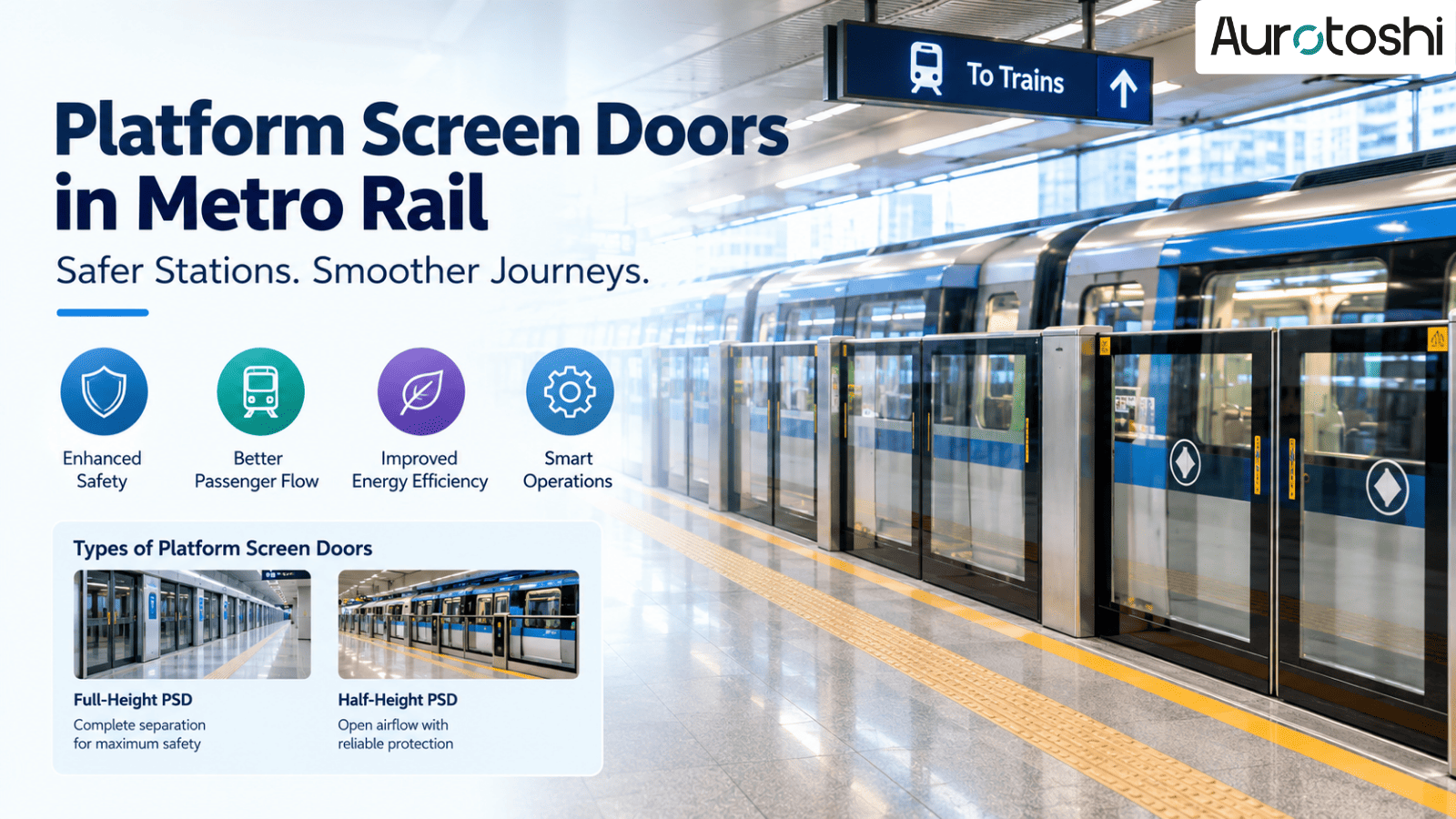
Platform screen doors are available in different configurations to suit station layouts, passenger requirements and operating conditions. The two main categories commonly discussed in metro projects are full-height and half-height systems.
1. Full-Height Platform Screen Doors
Full-height platform screen doors extend from the platform floor towards the ceiling or roof structure, depending on the design. They create a more complete physical separation between the passenger area and the track environment.
These systems are commonly considered for underground metro stations, enclosed platforms and projects where separation of the platform and track environments is an important requirement.
Key characteristics include:
• A tall physical barrier along the platform edge.
• Controlled access to the track area.
• Integration with train doors and relevant control systems.
• Potential to reduce air exchange between the platform and tunnel.
• Potential to reduce some train and track noise reaching the platform.
The exact benefits depend on the station design, ventilation arrangements and door configuration.
2. Half-Height Platform Screen Doors
Half-height platform screen doors, also called half-height platform screen gates in some projects, provide a physical barrier along the platform edge without extending to the ceiling.
They can help reduce the risk of accidental falls and unauthorized access to the track area while allowing greater airflow between the platform and track environment than a full-height enclosure.
These systems may be considered for elevated stations, open-air platforms and projects where full-height separation is not required or practical.
Important considerations include the barrier height, passenger behaviour, train-door alignment, platform layout and the operating requirements of the station.
3. Platform Edge Doors and Platform Gates
The terminology used for platform barriers can vary between railway systems and project specifications.
Platform edge doors and platform gates may differ in height, structure and the level of separation they provide. In some contexts, the terms are used to distinguish full-height barriers that do not reach the ceiling from shorter barriers installed at the platform edge.
For this reason, project teams should confirm the exact system definition, design drawings and applicable technical requirements before specifying equipment.
Full-Height vs Half-Height Platform Screen Doors
Choosing between full-height and half-height platform screen doors depends on the station environment, safety objectives, ventilation requirements and available infrastructure.
|
Feature |
Full-Height PSD |
Half-Height PSD |
|
Barrier Height |
Extends towards the ceiling or roof |
Covers part of the platform-edge height |
|
Track Separation |
More complete physical separation |
Physical barrier with an open area above |
|
Typical Applications |
Enclosed and underground metro stations |
Elevated and selected open-air stations |
|
Airflow |
Can help reduce air exchange between platform and track areas |
Allows more airflow between the two areas |
|
Noise Control |
Can reduce some noise transfer |
Generally offers less acoustic separation |
|
Installation |
May require coordination with ceiling and ventilation systems |
May be less intrusive in some station layouts |
|
Main Selection Factors |
Enclosure, climate control, safety and integration |
Platform layout, safety requirements and airflow |
Neither configuration is automatically suitable for every station. A detailed assessment of the station infrastructure, train fleet, passenger movement and operating requirements is necessary before choosing a system.
What Are the Benefits of Platform Screen Doors?
Platform screen doors can contribute to passenger safety and more controlled station operations. Their benefits depend on the system design, installation quality and integration with train operations.
1. Improved Passenger Safety
When closed, the doors help reduce the risk of accidental falls onto the tracks and restrict unauthorized access to the track area. They can also help reduce incidents involving objects falling onto the tracks.
2. Controlled Passenger Boarding and Alighting
Platform screen doors provide designated openings aligned with train doors, which supports an organized boarding process when door positions, passenger flow and operating procedures are properly planned.
3. Support for Automated Metro Operations
Automated and driverless metro systems require reliable coordination between trains, signalling, station equipment and passenger safety systems.
Platform screen doors can form part of this infrastructure by providing controlled access between the platform and train. Their operation must be integrated with the relevant train control and safety arrangements.
4. Potential Energy Efficiency Benefits
In underground or air-conditioned stations, full-height platform screen doors can reduce the exchange of conditioned air between the platform and tunnel.
This may help improve climate control and reduce some ventilation or cooling demands. Actual energy savings depend on factors such as station design, tunnel ventilation, climate conditions and HVAC operation.
5. Reduced Exposure to Train and Track Noise
Platform screen doors can reduce some noise from trains and the track environment reaching the passenger platform.
The level of noise reduction depends on door height, sealing, materials, station acoustics and the overall design.
6. Better Management of Platform Access
By restricting direct access to the track area when the doors are closed, PSD systems help establish a more controlled platform environment.
7. Support for Consistent Station Operations
Integrated door control, monitoring and fault-detection functions can help station personnel identify operational issues and coordinate maintenance.
These functions support reliable operation but do not eliminate the need for regular inspections, maintenance and emergency procedures.
How Do Platform Screen Doors Improve Passenger Safety?
Passenger safety involves more than installing a physical barrier. Platform screen doors must be designed, integrated and maintained according to the station's operating requirements.
Several functions contribute to safe operation.
Obstacle Detection
Depending on the system design, sensors can detect obstructions during door movement and trigger an appropriate response.
The detection arrangements must be suitable for the door mechanism and the safety requirements of the installation.
Emergency Release and Evacuation Arrangements
Platform screen door systems require provisions for abnormal conditions and emergencies. These may include manual release mechanisms, designated emergency doors, local control arrangements and procedures for evacuating passengers.
The appropriate features depend on the project design and applicable railway rules.
Monitoring and Maintenance
Regular inspections help identify mechanical wear, sensor faults, alignment problems and communication issues before they affect normal operations.
Maintenance planning should cover door mechanisms, control equipment, safety sensors and interfaces with train control systems.
What Is the Role of Train-Door Synchronization in PSD Systems?
The doors on the platform must correspond with the passenger doors of the train. If the train stops outside the permitted alignment range, normal automatic opening may not be authorized until the required conditions are satisfied.
For automated metro systems, the coordination between platform doors, train doors and signalling infrastructure is especially important.
The integration approach should be defined during project planning and validated through testing and commissioning.
Typical integration points include the interface between the central platform door controller and the signalling system, door status and fault reporting to the control room, local control panels for platform staff, and interlock arrangements that prevent a train departing with a door open or locked out. Each interface should be documented, simulated and tested during commissioning.
Where Are Platform Screen Doors Used?
Platform screen doors are primarily associated with metro and rail transit systems, but their suitability depends on the platform design and operational requirements.
Underground Metro Stations
Underground stations may use full-height platform screen doors to provide a physical barrier and help separate the platform environment from the tunnel.
Elevated Metro Stations
Elevated stations may use half-height platform screen doors or other suitable platform barrier systems, depending on the project design and safety requirements.
At-Grade Rail Stations
Selected at-grade stations may use platform door systems where controlled passenger access and train-door alignment can be achieved.
Automated and Driverless Metro Networks
Platform screen doors are commonly specified for automated and driverless lines, subject to signalling and train control integration.
Other Urban Transit Systems
Some urban rail and automated people-mover systems may also use platform barriers to manage passenger access and reduce track intrusion risks.
What Should Be Considered Before Installing Platform Screen Doors?
Installing platform screen doors requires coordination between civil infrastructure, rolling stock, signalling, electrical systems and station operations.
The following factors should be assessed before selecting a solution.
1. Platform Layout and Dimensions
The platform structure, available space, platform edge geometry and passenger circulation areas affect the door layout.
Installation planning should account for the required clearances, structural supports, access routes and maintenance space.
2. Train Configuration and Door Positions
The number and position of train doors must correspond with the platform door openings.
Projects with different train configurations or mixed fleets require careful compatibility assessments before the system is finalized.
3. Signalling and Train Control Integration
The PSD system must operate according to the project's train-control and signalling arrangements.
Interface definitions, operating sequences, interlocking requirements and failure responses should be established before installation.
4. Passenger Volume and Platform Flow
Passenger volumes influence platform design, door placement, circulation routes and boarding arrangements.
The design should consider peak-hour demand, accessibility, queue formation and the movement of passengers entering and leaving trains.
5. Safety and Emergency Requirements
The project must address emergency evacuation, manual release, maintenance access and abnormal operating conditions.
Relevant railway rules, technical specifications and safety approvals should guide the system design.
6. Environmental and Operating Conditions
Temperature, humidity, dust, vibration and other site conditions can affect equipment selection and maintenance requirements.
The system should be specified for the operating environment of the station.
7. Maintenance and Long-Term Support
Platform screen doors are used repeatedly throughout the day. The project team should consider spare parts, preventive maintenance, fault diagnosis, service access and support arrangements.
A planned maintenance programme can help reduce unexpected downtime and maintain safe operation.
What Are the Common Challenges in Platform Screen Door Installation?
Although platform screen doors offer important safety benefits, installation and integration require careful engineering.
Integration With Existing Stations
Retrofitting platform doors into an operational station can be more complex than installing them during new construction. Existing platform structures, train fleets, signalling arrangements and limited maintenance windows may affect the installation plan.
Train and Platform Alignment
The door openings must align with the train doors within the permitted operating range. Differences in rolling stock or stopping positions can create design and integration challenges.
Coordination Across Multiple Systems
PSD equipment must work with train control, signalling, station power, communication and safety arrangements. Poorly defined interfaces can lead to commissioning delays or operational issues.
Maintenance During Operating Hours
Metro stations often operate for long hours, leaving limited time for maintenance. Preventive maintenance and fault-response plans must be coordinated with the station's operating schedule.
Emergency Planning
Emergency procedures must address situations such as door failures, power interruptions, obstructions and passenger evacuation. Staff training and periodic testing are important parts of operational readiness.
These challenges can be managed more effectively when the system requirements, interfaces and maintenance responsibilities are defined early in the project.
Platform Screen Doors in Indian Metro Projects
Platform screen doors are an important consideration in India's expanding metro infrastructure, where passenger safety, reliable operation and efficient station management remain key priorities.
The Delhi Metro Railways General Rules and related Indian metro guidance describe platform door types and outline requirements for normal operation and abnormal or emergency conditions. These provisions highlight the importance of correct train positioning, coordinated door operation and defined emergency arrangements.
Platform screen door installations also demonstrate the need to consider local station conditions rather than applying the same design to every project. Underground, elevated and at-grade stations can have different requirements for barrier height, ventilation, train alignment and maintenance access.
Aurotoshi has commissioned half-height platform screen gates for Mumbai Metro Line 2B Phase 1 at BSNL, Mankhurd and Mandale stations. This project provides a relevant example of platform door systems being deployed in India's urban transit infrastructure.
For new metro lines and station upgrades, the appropriate solution should be selected according to the project specification, train configuration, signalling architecture and applicable safety requirements.
Platform Screen Door Solutions for Modern Metro Infrastructure
Choosing a platform screen door supplier requires consideration of engineering, manufacturing, integration and long-term support. The doors must suit the station layout and train configuration while meeting the operating requirements of the transit network.
Aurotoshi provides platform screen door solutions for underground, elevated and at-grade metro stations, with configurations designed around project-specific requirements. The systems incorporate features such as synchronized door operation, obstacle detection, intelligent door control, emergency release and signalling-system integration.
For metro authorities, EPC contractors and system integrators, Aurotoshi's Platform Screen Door solutions can be evaluated according to the project's platform dimensions, rolling stock, train-control interfaces, passenger volumes and maintenance requirements.
Aurotoshi combines in-house hardware manufacturing with the transit technology and software integration expertise of its parent group, Aurionpro Solutions.
Aurotoshi (An Aurionpro Group Company) brings 30+ years of manufacturing experience, three manufacturing units and OEM/ODM capabilities to these projects. The selection process should also consider testing, commissioning, preventive maintenance and support for the full operating life of the equipment.
Frequently Asked Questions
1. What are platform screen doors in a metro station?
Platform screen doors are powered barriers installed along the edge of a metro platform to separate passengers from the train tracks. They open in coordination with train doors when the train is correctly positioned, allowing passengers to board and leave safely.
2. How do platform screen doors work?
A control system coordinates the platform doors with train position and signalling, so the doors open and close together with the train doors.
3. What are the different types of platform screen doors?
The two main configurations are full-height platform screen doors and half-height platform screen doors. Full-height systems provide a more complete separation between the platform and track environment, while half-height systems create a physical barrier without enclosing the full height of the platform edge.
4. What is the difference between full-height and half-height platform screen doors?
Full-height platform screen doors extend towards the ceiling or roof structure and can help reduce air exchange between the platform and track area. Half-height platform screen doors provide a shorter physical barrier and allow greater airflow between these areas. The right option depends on station design, safety objectives and operating conditions.
5. What are the benefits of platform screen doors?
Platform screen doors help reduce the risk of accidental falls onto tracks, restrict unauthorized track access and support controlled passenger boarding. Depending on the design, they can also reduce some noise and improve climate control in enclosed stations.
6. Are platform screen doors mandatory in metro stations?
Requirements vary according to the applicable railway rules, project specifications and safety assessments. The need for platform screen doors should be evaluated against the relevant regulatory requirements, station design and operational risk considerations.
7. Do platform screen doors open automatically with train doors?
In systems designed for synchronized operation, platform screen doors open and close in coordination with train doors when the train is correctly positioned and the required control conditions are satisfied. The precise operating sequence depends on the train-control and signalling architecture.
8. Can platform screen doors be installed in existing metro stations?
Yes, platform screen doors can be considered for existing stations, but retrofitting requires detailed planning. Platform structure, train-door positions, signalling interfaces, electrical infrastructure and installation access must be assessed before work begins.
9. Do platform screen doors reduce energy consumption?
Full-height platform screen doors can reduce air exchange between the platform and tunnel in suitable enclosed stations. This may improve HVAC efficiency, although the actual energy savings depend on the station's ventilation system, climate and operating conditions.
10. Are platform screen doors suitable for driverless metro systems?
Yes. Platform screen doors can be integrated into driverless and automated metro systems when the door controls, train positioning, signalling and safety arrangements are designed to work together. They provide a physical barrier between passengers and the track area.
11. What maintenance is required for platform screen doors?
Maintenance generally includes inspection of door panels, drive mechanisms, sensors, control units, electrical components and signalling interfaces. Emergency release mechanisms and door synchronization should also be checked according to the approved maintenance schedule.
12. What should be considered when selecting a platform screen door manufacturer in India?
Consider engineering capabilities, system integration, compatibility with train configurations, safety features, manufacturing quality, testing and commissioning support, spare parts availability and long-term maintenance. Experience with relevant transit projects and compliance with project-specific technical requirements are also important.
Conclusion
Platform screen doors are an important safety component in modern metro and rail infrastructure. By creating a physical barrier between passengers and train tracks, they help reduce the risk of accidental falls and unauthorized access while supporting controlled boarding and alighting.
Selecting the right system involves more than deciding between full-height and half-height doors. Train alignment, signalling integration, passenger flow, station structure, emergency procedures and maintenance requirements all influence the final design.
For metro authorities, railway planners and infrastructure contractors, a well-planned platform screen door system can contribute to safer passenger movement and more reliable station operations. Careful engineering, appropriate integration and regular maintenance are essential to achieving these benefits over the system's operating life.