Modern metro stations, airports and transit facilities handle thousands of passengers every day. Managing this movement efficiently requires more than physical infrastructure. Transportation facilities need automated systems that can control access, improve safety, support passenger processing and integrate with existing operational systems.
This is where passenger flow management systems play an important role.
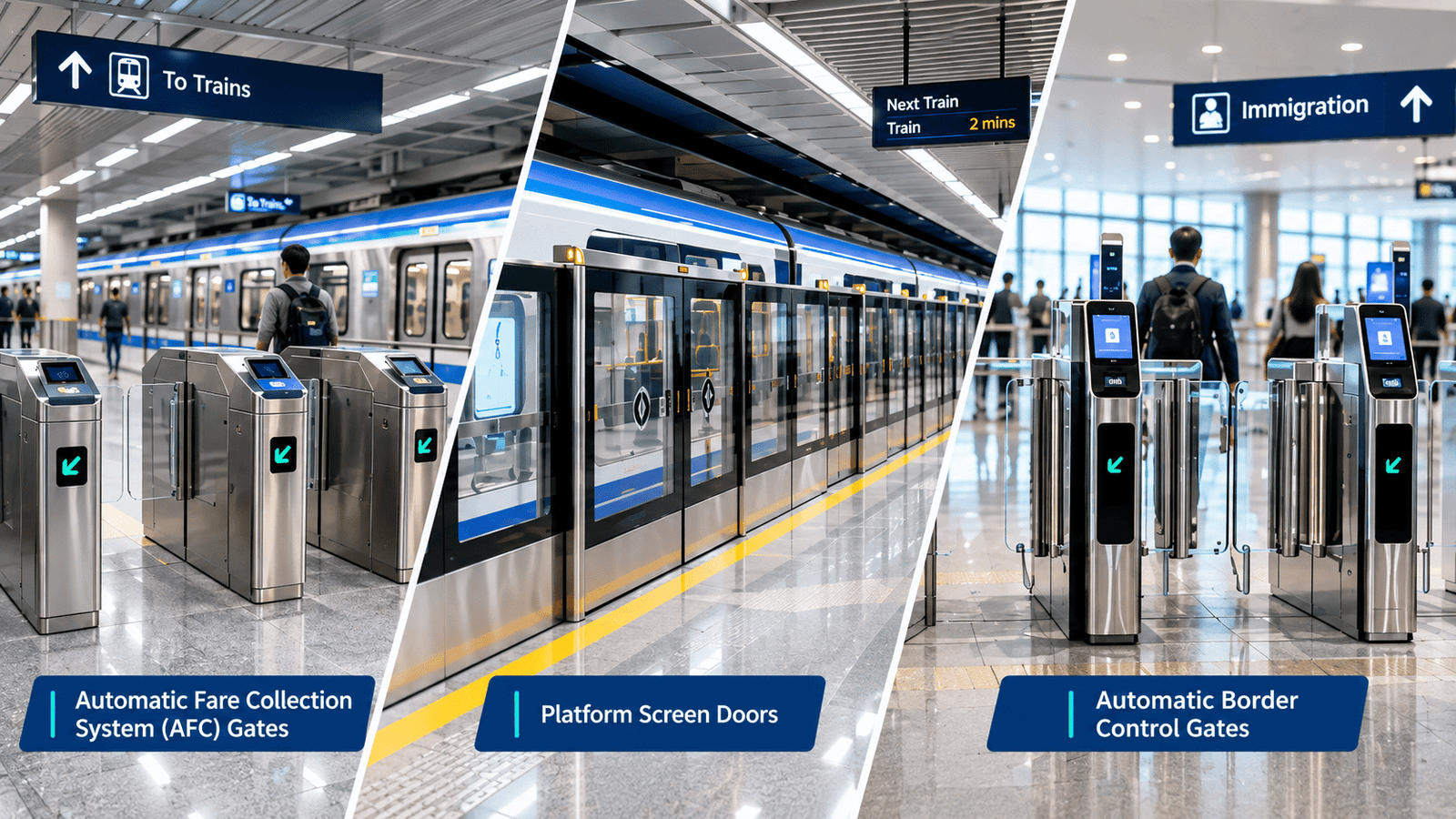
Automatic Fare Collection Gates help manage controlled entry and exit at metro and transit stations. Platform Screen Doors create a safety barrier between passengers and the track area. Automatic Border Control Gates support automated identity verification and controlled immigration processing at airports and border checkpoints.
Although these systems perform different functions, they all contribute to safer, more organized and efficient passenger movement. The right choice depends on which stage of passenger movement is actually being controlled, not on which system sounds the most advanced.
What Are Passenger Flow Management Systems?
Passenger flow management systems are automated technologies used to control and monitor the movement of people through transportation facilities.
Depending on the application, these systems can manage:
• Passenger entry and exit
• Fare and ticket validation
• Access control
• Platform safety
• Identity verification
• Biometric authentication
• Passport and travel document verification
• Passenger throughput
• Controlled access to restricted areas
The technology required depends on the location and purpose of the control point, not on passenger volume alone.
In metro systems, AFC gates manage passenger access while Platform Screen Doors provide protection at the platform, and these are not interchangeable: an AFC gate cannot substitute for platform safety, and a Platform Screen Door cannot validate a fare. At airports and immigration checkpoints, Border Control Gates automate identity verification and controlled passenger clearance, a distinct function from both.
Automatic Fare Collection Systems for Metro and Transit
Metro stations need to process passengers quickly while ensuring that only authorized passengers enter the paid area.
An Automatic Fare Collection System India solution helps automate this process by validating a passenger's travel credential before allowing access.
Depending on the fare collection system, AFC gates can support technologies such as smart cards, QR-based tickets and other electronic travel credentials.
Aurotoshi AFC Gates are available in flap and swing configurations and are designed for metro stations, BRTS and other high-volume passenger environments. The systems can support uni-directional or bi-directional operation and integrate with different ticketing technologies.
An AFC gate is the right choice when the requirement is fare validation and controlled access to a paid transit area, rather than platform safety or identity verification, which are separate problems solved by different systems.
Key Features of AFC Gates
Modern Automatic Fare Collection Gates can include:
• Fast passenger processing
• Obstacle detection
• Anti-tailgating
• Anti-pass-back
• Uni-directional and bi-directional operation
• Ticketing system integration
• Emergency operation
• Fire alarm integration
• Real-time access control
Aurotoshi's specified AFC configuration supports 40 to 45 persons per minute, with opening and closing time of less than 0.5 second. The system also includes 16 pairs of IR sensors and is designed for high-cycle operation. A station with heavier peak-hour footfall should size gate count around this per-lane throughput rather than assuming a single lane will handle the full passenger volume.
Where Are AFC Gates Used?
AFC gates are commonly suitable for:
• Metro stations
• BRTS
• Mass transit systems
• Railway environments
• High-volume passenger facilities
The correct configuration depends on passenger volume, ticketing technology, passage requirements, operating direction and integration with the existing fare collection infrastructure.
Platform Screen Doors for Metro Passenger Safety
Passenger access is only one part of metro station management. Once passengers reach the platform, protecting them from the track area becomes another important requirement.
Platform Screen Doors create a physical barrier between passengers and the track area. They are designed to operate in synchronization with train doors and can integrate with signalling and train-control systems.
Aurotoshi Platform Screen Doors are designed for underground, elevated and at-grade metro stations. The systems support synchronized door operation, obstacle detection, intelligent door control, emergency release and signalling-system integration. Aurotoshi has commissioned Half-Height Platform Screen Gates for Mumbai Metro Line 2B Phase 1 at the BSNL, Mankhurd and Mandale stations, an example of the signalling and train-control integration this product category requires in practice.
Platform Screen Doors are the right system specifically for platform-track safety separation in metro environments; they are not a substitute for access control at the entry gate, and a Platform Screen Door Manufacturer in India should be evaluated on train and signalling compatibility as much as on the physical door system itself.
How Platform Screen Doors Work
Platform Screen Doors remain closed when a train is not correctly positioned at the platform. Once the train arrives and the required conditions are confirmed, the doors can operate in coordination with the train doors.
This provides controlled access between the platform and train while maintaining a physical barrier when trains are not at the station.
Important features include:
• Train door synchronization
• Obstacle detection
• Intelligent door control
• Emergency release
• Signalling integration
• Controlled track access
• Continuous operational monitoring
Platform Screen Doors for Different Metro Environments
Platform Screen Doors can be designed for:
• Underground metro stations
• Elevated metro stations
• At-grade stations
• Automated metro systems
• Driverless metro systems
• BRT applications
The final configuration depends on the station design, train dimensions, door positions, signalling system and project-specific requirements. Driverless and automated metro lines in particular require tighter signalling integration than a conventionally staffed line, since there is no driver to visually confirm platform clearance before departure.
Automatic Border Control Gates for Airports
Airports and immigration checkpoints have different passenger processing requirements from metro stations. Here, the system must verify the traveller's identity and authorize access before the person can proceed.
Automatic Border Control Gates automate this process by combining controlled access with identity verification technologies.
Aurotoshi Border Control Gates are designed for automated immigration processing and can support biometric authentication, passport reader integration, real-time verification and intelligent access control.
Border Control Gates are the right choice when the requirement is verified identity and travel-document authentication rather than simple fare or access validation, which is why they are standard at airports and immigration checkpoints rather than metro stations. For organizations evaluating a Border Control Gate Manufacturer India, important considerations include authentication technology, document verification, passenger throughput, anti-tailgating, emergency operation and integration with immigration and security systems.
Key Features of Border Control Gates
Automatic Border Control Gates can include:
• Biometric authentication
• Passport reader integration
• Facial recognition
• Real-time verification
• Anti-tailgating
• Anti-pass-back
• Mantrap configuration
• Emergency override
• Fire alarm integration
• Intelligent access control
Aurotoshi's ABC3610 configuration supports 20 to 25 travellers per minute, with opening and closing time below 1 second. It uses 23 pairs of IR sensors, supports mantrap operation and includes anti-tailgating and anti-pass-back functions.
The system can also be configured with passport scan, RFID, fingerprint, QR, face, iris and Morpho access-control options, and the combination selected should match the document types and verification level the facility is actually required to support, rather than defaulting to the fullest specification available.
AFC Gates vs Platform Screen Doors vs Border Control Gates
Although all three technologies are part of passenger automation, their functions are different.
|
System |
Main Purpose |
Typical Application |
Key Requirement |
|
AFC Gates |
Passenger access and fare validation |
Metro, BRTS and transit stations |
Fast authentication and passenger throughput |
|
Platform Screen Doors |
Passenger and track separation |
Metro stations |
Safety and train-door synchronization |
|
Border Control Gates |
Identity verification and controlled access |
Airports and immigration checkpoints |
Secure authentication and passenger processing |
AFC gates control who enters or exits a controlled fare area.
Platform Screen Doors control the interface between passengers and the train platform and track area.
Border Control Gates control access after identity and travel-document verification.
A project that conflates these functions, for example specifying a Border Control Gate where an AFC gate is what's actually needed, ends up paying for authentication capability the application will never use. Understanding this difference is what keeps a transportation automation project correctly scoped.
How These Systems Improve Passenger Flow
Passenger automation can improve transportation operations in several ways.
Faster Passenger Processing
Automated gates reduce the need for manual checks at every passenger access point and can support high passenger volumes.
Controlled Access
Automated systems allow access only after the required ticket, credential or identity verification has been completed.
Improved Safety
Platform Screen Doors create a physical barrier at metro platforms, while AFC and Border Control Gates can include sensors and controlled access functions.
Better Operational Control
Automated systems can connect with wider ticketing, signalling, access-control, biometric or immigration infrastructure.
Reduced Manual Intervention
Automating routine passenger processing allows staff to focus on supervision, exceptions and other operational requirements.
How to Choose the Right Passenger Flow Management System
Selecting the right system requires an understanding of the facility and its operational requirements, starting with which stage of the passenger journey is actually being controlled.
Passenger Volume
Determine normal and peak passenger volumes. High-traffic metro stations and airports require equipment designed for continuous passenger processing, and gate count should be planned around the per-lane throughput of the chosen system rather than an assumed total.
Integration Requirements
AFC gates may need integration with fare collection systems. Platform Screen Doors need compatibility with signalling and train-control systems. Border Control Gates may require passport, biometric and immigration-system integration. Mismatching a system to the wrong integration environment is one of the more common planning errors on transit projects.
Safety and Security
Consider obstacle detection, anti-tailgating, anti-pass-back, emergency release and other safety functions relevant to the application.
Passage Requirements
Passenger flow, accessibility requirements and lane width should be considered when selecting the gate configuration.
Operating Environment
The system should be suitable for its intended environment, whether it is a metro station, BRTS facility, airport or immigration checkpoint.
Maintenance and Service
Long-term operation is an important part of passenger automation. Preventive maintenance, spare parts, fault diagnosis and breakdown support should be considered during project planning, since these systems typically run continuously across a station's operating hours rather than intermittently.
Aurotoshi Passenger Automation Solutions
Aurotoshi provides passenger automation solutions for modern travel and mobility infrastructure, including:
• Automatic Fare Collection Gates
• Platform Screen Doors
• Automatic Border Control Gates
• Ticket Vending Machines
The AFC portfolio includes flap and swing configurations for controlled passenger access. Platform Screen Doors are designed for underground, elevated and at-grade metro applications, as demonstrated on the Mumbai Metro Line 2B Phase 1 project, while Border Control Gates support automated immigration and passenger verification requirements.
With more than 30 years of engineering experience, three manufacturing units and OEM and ODM capabilities, Aurotoshi supports transportation automation requirements from system configuration through installation and long-term service.
Frequently Asked Questions
What is an Automatic Fare Collection System?
An Automatic Fare Collection System is an automated technology used to validate passenger tickets or travel credentials and control access to the paid area of a public transport facility.
What is an AFC gate?
An AFC gate is an automated passenger gate that validates a travel credential before allowing entry or exit. AFC gates are commonly used in metro stations, BRTS and other mass-transit environments.
What are Platform Screen Doors?
Platform Screen Doors are automated barriers installed along metro platforms to separate passengers from the track area. They can operate in synchronization with train doors and integrate with signalling and train-control systems.
Why are Platform Screen Doors used in metro stations?
Platform Screen Doors help provide a physical barrier between passengers and the track area while supporting controlled boarding and alighting. They are also suitable for modern automated and driverless metro applications.
What is an Automatic Border Control Gate?
An Automatic Border Control Gate is an automated immigration gate that verifies a traveller's identity and allows controlled access after the required authentication checks are completed.
How do automatic border control gates work?
Automatic Border Control Gates can use passports, biometric information and other supported credentials to verify a traveller. After successful verification, the system controls access through the gate.
What is the difference between AFC gates and border control gates?
AFC gates are primarily used for fare validation and controlled passenger access in public transportation. Border Control Gates are designed for identity verification and automated immigration processing.
Can AFC gates support QR tickets?
Yes. Aurotoshi's specified AFC configuration supports CSC, EMV and paper QR ticket media.
Are Platform Screen Doors suitable for driverless metro systems?
Yes. Platform Screen Doors can be designed for automated and driverless metro systems when properly integrated with the train-control and signalling architecture.
How fast can AFC gates process passengers?
Aurotoshi's specified AFC configuration supports a throughput of 40 to 45 persons per minute, with an opening and closing time of less than 0.5 second.
How many travellers can an automatic border control gate process?
Aurotoshi's ABC3610 configuration is specified for 20 to 25 travellers per minute, with an opening and closing time below 1 second.
What should I consider when selecting passenger flow management systems?
Passenger volume, system integration, safety, security, authentication technology, passage requirements, operating environment, maintenance and long-term service support should all be considered before selecting a passenger automation system.
Conclusion
Passenger flow management is an important part of modern metro, airport and transit infrastructure. AFC Gates help manage fare-based passenger access, Platform Screen Doors provide controlled separation between passengers and the track area, and Border Control Gates automate identity verification at immigration checkpoints.
Each technology addresses a different stage of passenger movement, so the right solution depends on which stage of the journey is being controlled, not on selecting the most feature-rich system available.
Aurotoshi provides AFC Gates, Platform Screen Doors and Automatic Border Control Gates for modern travel and mobility applications, with project delivery including the Mumbai Metro Line 2B Phase 1 Platform Screen Gate installation, supporting the growing need for automated passenger processing and controlled movement in India.