Industrial facilities need more than a strong boundary. They need an entrance system that can control vehicle movement, manage access and operate reliably under daily traffic. This is where Industrial Gates play an important role at manufacturing plants, warehouses, logistics facilities, industrial estates and commercial premises.
The right gate depends on several site factors, including driveway width, available side space, ground conditions, gate weight, traffic frequency and the level of access control required. Businesses looking for an Industrial Gate Manufacturer India should therefore evaluate the complete gate system rather than choosing a product based only on appearance or initial price.
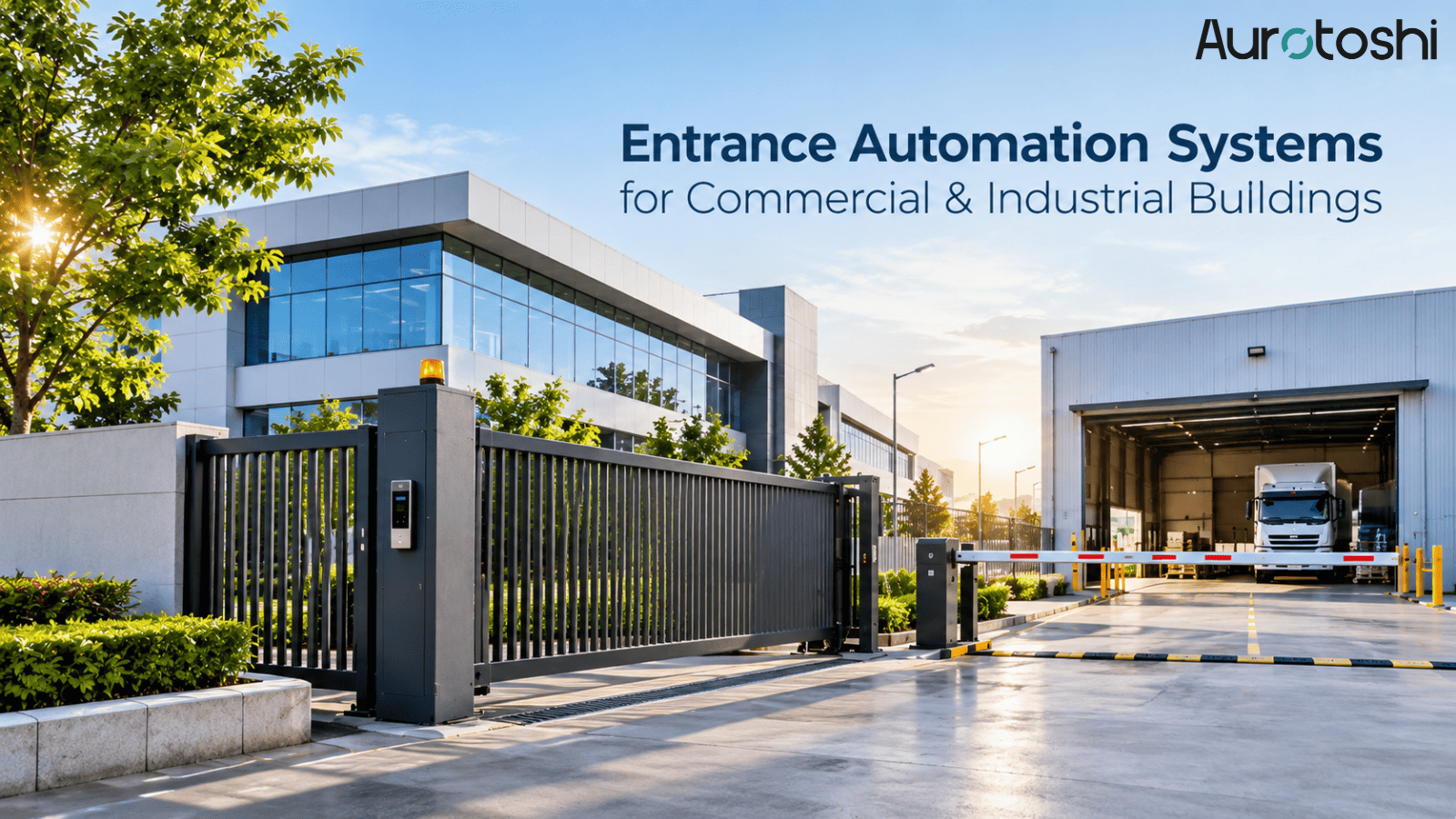
Aurotoshi manufactures industrial entrance gates in sliding, telescopic, cantilever, swing and retractable configurations. These options are designed for different site conditions and can be integrated with modern access-control systems for controlled vehicle entry and exit.
What Are Industrial Gates?
Industrial gates are automated or motorized entrance systems used to control vehicle and perimeter access to industrial and commercial properties. They are generally installed at boundary walls, fencing lines, plant entrances, warehouse premises and other controlled access points.
Unlike a basic manual gate, an automated industrial entrance gate can be connected with access-control equipment to manage authorised vehicle movement. Depending on the application, systems can work with RFID readers, ANPR cameras, biometric systems, loop detectors and intercoms.
The gate configuration should be selected according to the physical site and operational requirements. A wide industrial entrance with limited side space, for example, may require a telescopic configuration, while a site affected by flooding or uneven ground may be better suited to a cantilever gate.
Types of Industrial Entrance Gates
There is no single gate configuration suitable for every industrial entrance. A reliable Industrial Gate Manufacturer India should be able to recommend the right design according to opening size, traffic conditions and available installation space.
1. Automatic Sliding Gates
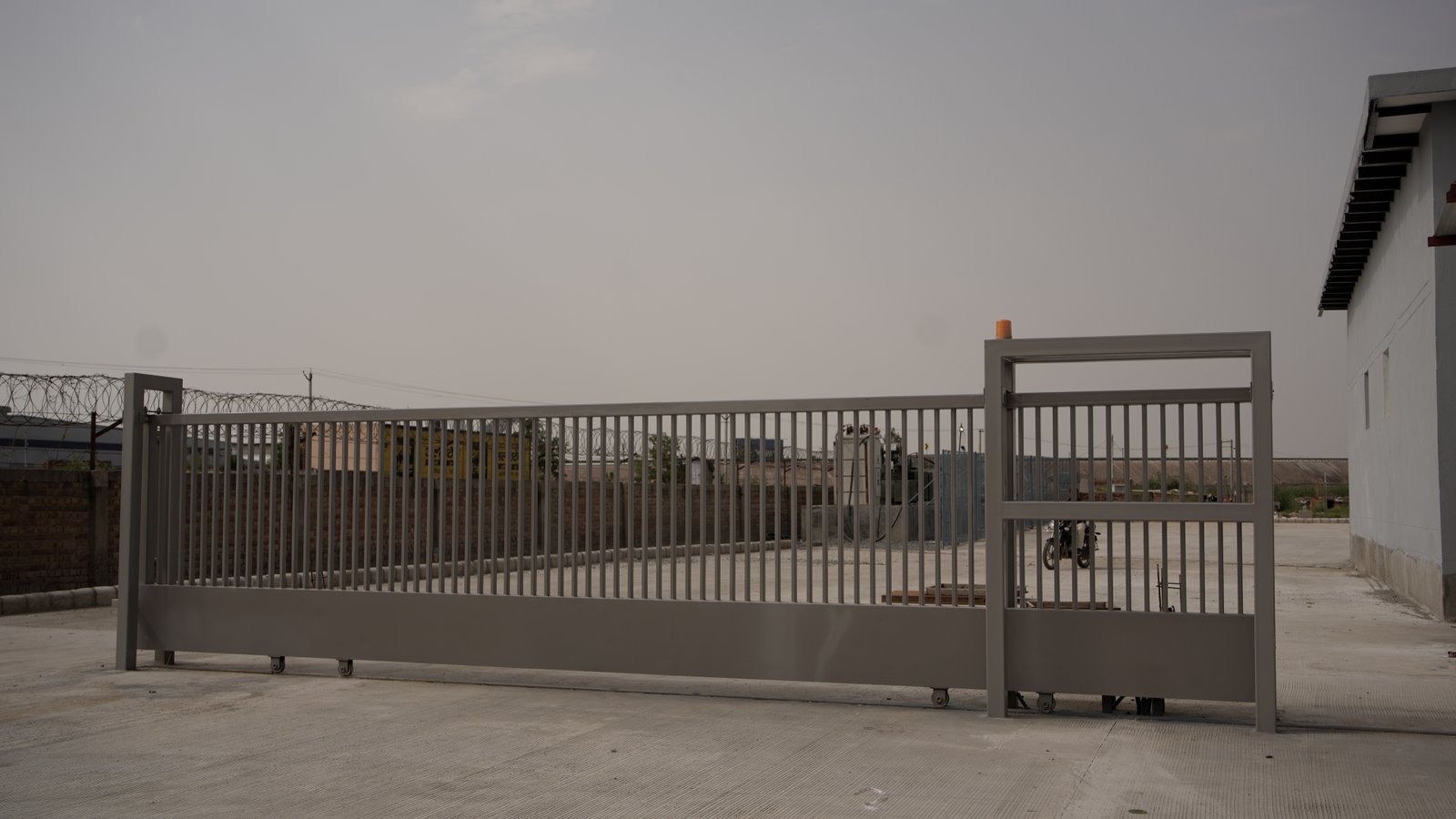
Sliding gates are commonly used for main plant entrances, industrial estates and large vehicle access points where sufficient side run-back is available.
Aurotoshi's sliding gates use a welded MS or SS leaf with galvanised wheels and a polished bottom rail. The configuration supports gate weights from 500 to 6000 kg and clear openings of up to 50 metres for a single leaf.
The standard sliding gate uses an AC geared European drive and operates at up to 0.2 m/s. It is suitable where a conventional ground-running gate arrangement can be accommodated.
2. Telescopic Sliding Gates
Telescopic gates are useful when a wide entrance needs to be closed but the site does not have enough side space for a conventional sliding gate.
The gate uses multiple leaves that move and nest together, reducing the required side run-back compared with a conventional sliding configuration.
This makes Telescopic Sliding Gates suitable for industrial sites, warehouses and commercial properties where the driveway is wide but available side space is limited.
3. Cantilever Sliding Gates
Cantilever gates are designed for sites where a ground track is not practical.
Instead of running on a ground rail, the gate leaf is supported by post-mounted rollers. This keeps the driveway clear of a ground track and can be useful in locations affected by flooding, silt, snow or uneven driving surfaces.
Aurotoshi's cantilever configuration supports gate weights from 500 to 6000 kg and clear openings up to 12 metres.
4. Automatic Swing Gates
Swing gates are a practical option for narrower entrances where there is sufficient clearance for the gate leaf to open through a swing arc.
They can be suitable for sites with lower traffic volumes where the physical layout allows the gate leaf to operate without interfering with vehicles, pedestrians or surrounding structures.
Aurotoshi's swing gate configuration supports gate weights from 300 to 2000 kg and clear openings up to 10 metres.
5. Automatic Retractable Gates
Retractable gates are designed for wide entrances where conventional side run-back is not available.
The gate uses a self-supporting fin assembly that retracts into the gate head, allowing wide openings to be secured without requiring a long side run-back area.
Aurotoshi's retractable configuration supports openings up to 25 metres and is suited to wide entrances and premium commercial or industrial frontages.
Industrial Gate Comparison
The right configuration depends primarily on site conditions rather than simply selecting the largest or fastest gate.
|
Gate Type |
Best For |
Ground Track |
Max Clear Opening |
Max Gate Weight |
|
Sliding Gate |
Main plant and estate entrances |
Yes |
Up to 50 m |
500 to 6000 kg |
|
Telescopic Sliding Gate |
Wide openings with limited side space |
Yes |
Up to 75 m |
500 to 6000 kg |
|
Cantilever Gate |
Sites where a ground track is unsuitable |
No |
Up to 12 m |
500 to 6000 kg |
|
Swing Gate |
Narrower openings with clear swing space |
No |
Up to 10 m |
300 to 2000 kg |
|
Retractable Gate |
Wide openings with no side run-back |
No |
Up to 25 m |
Self-supporting assembly |
These specifications are based on Aurotoshi's published Entrance Gates range. Actual gate selection should be based on the site's opening dimensions, traffic pattern, structural conditions and access requirements.
How to Choose the Right Industrial Gate
Choosing an industrial gate should start with the site rather than the gate model.
1. Check the Available Side Space
Sliding gates require adequate side run-back to accommodate the gate leaf. If the available side space is limited, a telescopic or retractable configuration may be more suitable.
2. Measure the Clear Opening
The required opening width directly affects the gate configuration. Large industrial driveways may require multi-leaf telescopic systems or other specialised configurations.
3. Consider Ground Conditions
A ground-running sliding gate requires a suitable track. If the site experiences flooding, silt accumulation or uneven ground conditions, a cantilever gate can eliminate the need for a ground rail across the driveway.
4. Evaluate Vehicle Traffic
Consider the type and frequency of vehicle movement. A manufacturing plant with frequent truck movement may have different requirements from a commercial facility with occasional vehicle access.
5. Check Gate Weight
The gate operator must be selected according to the actual gate weight and configuration. Aurotoshi's published configurations support gate weights from 500 kg up to 6000 kg for several industrial gate types.
6. Plan Access Control
For controlled industrial premises, the gate can be integrated with access-control systems. RFID, ANPR, biometric readers, loop detectors and intercoms can be connected directly to the gate system to manage authorised vehicle movement.
7. Consider Safety Requirements
Automated gates operate around vehicles and people, so safety systems should be considered during the initial design.
Aurotoshi's Entrance Gates use infrared photocells with a range of up to 20 metres and stop-and-reverse operation when the beam is interrupted. The system also includes a key-operated manual release for manual operation during power loss.
Industrial Gate Automation and Access Control
Modern Industrial Entrance Gates can form part of a wider perimeter security and access-control system.
For example, an industrial facility can integrate its entrance gate with:
• RFID access cards
• Automatic Number Plate Recognition (ANPR)
• Biometric readers
• Vehicle loop detectors
• Intercom systems
• Other access-control equipment
This allows authorised vehicles to enter without requiring security personnel to manually operate the gate for every movement.
For high-security industrial premises, integrating the gate with the site's existing access-control infrastructure can also help create a more controlled and traceable entry process.
Where Are Industrial Entrance Gates Used?
Industrial gates are used wherever controlled vehicle access is required.
Manufacturing Plants
Manufacturing facilities often have regular movement of trucks, employee vehicles, suppliers and other authorised traffic. Automated gates can help control this movement at the main boundary entrance.
Warehouses and Logistics Facilities
Warehouses and logistics centres require efficient vehicle movement through loading and dispatch areas. Gate selection should account for vehicle size, traffic frequency and available installation space.
Industrial Estates
Large industrial estates may require wide entrance gates capable of handling frequent vehicle movement while maintaining controlled access.
Commercial Facilities
Commercial properties can use automated entrance gates to manage vehicle access while maintaining a secure and organised frontage.
High-Security Facilities
Facilities with strict access requirements can integrate industrial gates with ANPR, RFID, biometric and other access-control systems.
Safety and Standards for Industrial Gates
Safety should be considered as part of the gate system rather than as an additional feature after installation.
Aurotoshi's Entrance Gates are designed around EN 13241-1, while infrared photocell safety is specified to EN 12453. The gate range also includes double self-locking and key-operated manual release features.
The published product specifications also identify CE certification and a CE-certified RIB Italy drive for the gate range.
When evaluating an Industrial Gate Manufacturer India, businesses should ask for the applicable standards, safety-system specifications and technical documentation for the selected configuration.
Why Choose an Experienced Industrial Gate Manufacturer?
Industrial entrance gates are part of a larger access and perimeter-management system. The manufacturer should therefore understand more than the gate itself.
An experienced manufacturer should be able to assess:
• Site layout
• Opening dimensions
• Available run-back
• Gate weight
• Ground conditions
• Vehicle traffic
• Access-control requirements
• Safety requirements
• Installation conditions
• Maintenance and replacement requirements
Aurotoshi manufactures its entrance gate range in-house in Ghaziabad and maintains local stock of operators, wheels and controllers to support replacement requirements. Its product range covers five gate configurations for different industrial and commercial applications.
Why Consider Aurotoshi for Industrial Entrance Gates?
Aurotoshi provides Industrial Entrance Gates for facilities requiring controlled vehicle access across boundary walls, fence lines, industrial premises, warehouses and commercial properties.
The range includes:
• Automatic Sliding Gates
• Telescopic Sliding Gates
• Cantilever Sliding Gates
• Automatic Swing Gates
• Automatic Retractable Gates
The gates can be configured according to opening size, available side space, ground conditions and traffic requirements. Access-control integration is also available for RFID, ANPR, biometric readers, loop detectors and intercom systems.
With 30+ years of manufacturing experience, 3 manufacturing units and OEM/ODM capabilities, Aurotoshi supports industrial automation requirements with in-house manufacturing and application-specific solutions, alongside related building-envelope products such as Rolling Shutters, High Speed Doors, and Dock Levelers.
Frequently Asked Questions
1. What is an industrial gate?
An industrial gate is a heavy-duty entrance gate used to control vehicle access to facilities such as manufacturing plants, warehouses, logistics centres, industrial estates and commercial premises. It can be automated and integrated with access-control systems.
2. Which type of industrial gate is best?
The right type depends on the site. Sliding gates are suitable where full side run-back is available, telescopic gates work well where side space is limited, cantilever gates are useful where a ground track is unsuitable, swing gates suit openings with sufficient swing clearance, and retractable gates are suitable for wide openings without side run-back.
3. What is the difference between a sliding gate and a cantilever gate?
A sliding gate normally runs along a ground rail, while a cantilever gate is supported by post-mounted rollers and does not require a ground track across the driveway. Cantilever gates can therefore be useful where flooding, silt or uneven ground makes a conventional track unsuitable.
4. What is an automatic sliding gate?
An automatic sliding gate is a motorized gate that moves horizontally along a track to control vehicle access. It can also be integrated with access-control systems such as RFID, ANPR, biometrics and vehicle loop detectors.
5. How wide can an industrial gate be?
The maximum opening depends on the gate configuration. Aurotoshi's published specifications provide clear openings up to 50 metres for a single-leaf sliding gate, up to 75 metres for a multi-leaf telescopic gate and up to 25 metres for a retractable gate.
6. Can industrial gates be integrated with access control?
Yes. Industrial gates can be integrated with access-control systems such as RFID, ANPR, biometric readers, loop detectors and intercoms. Aurotoshi's gate systems support direct integration with these access-control technologies.
7. Are automatic industrial gates safe?
Safety depends on the gate design, automation system and installed safety devices. Aurotoshi's Entrance Gates include infrared photocell protection with stop-and-reverse operation and are specified with EN 12453 safety requirements.
8. How much does an industrial gate cost in India?
The cost depends on the gate type, opening size, gate weight, material, automation, access-control integration and site requirements. A site-specific quotation is more appropriate than using a standard price for an industrial gate.
9. How do I choose an Industrial Gate Manufacturer India?
Look for a manufacturer with actual manufacturing capability, suitable gate configurations, documented technical specifications, safety compliance, access-control integration, installation support and after-sales service. The manufacturer's ability to recommend a configuration based on your actual site conditions is also important.
10. Can industrial gates be customised?
Yes. Industrial gate configurations can be selected according to opening width, gate weight, available side space, ground conditions, traffic requirements and access-control needs. A site assessment helps determine the appropriate configuration.
Final Takeaway
Selecting an industrial entrance gate should not be based only on the gate's appearance or initial purchase price. The right solution needs to match the site's opening width, available space, ground conditions, vehicle traffic, gate weight, safety requirements and access-control system.
Sliding, telescopic, cantilever, swing and retractable gates each solve different site requirements. Selecting the correct configuration can improve vehicle access management while providing a more practical and controlled entrance to an industrial facility.
For businesses evaluating an Industrial Gate Manufacturer India, Aurotoshi offers five industrial entrance gate configurations, CE-certified drive options, EN 13241-1 conformity, EN 12453 photocell safety and direct access-control integration. With 30+ years of manufacturing experience, 3 manufacturing units and OEM/ODM capabilities, Aurotoshi can support standard and application-specific industrial gate requirements.