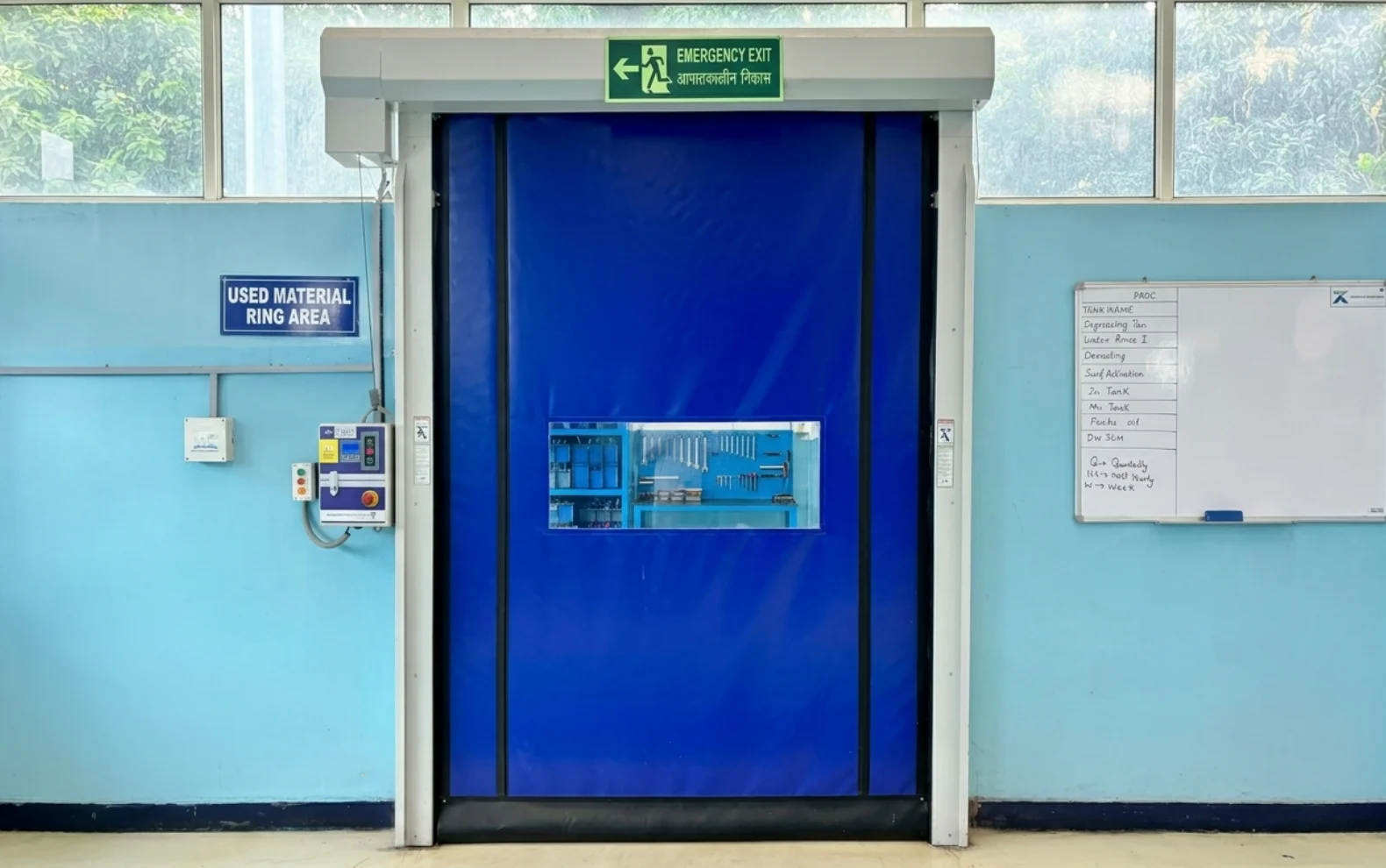
High speed doors are no longer limited to a few specialised industrial facilities. They are increasingly used in warehouses, manufacturing plants, logistics centres, food processing units, pharmaceutical facilities, cold storage facilities and other high-traffic environments where conventional doors can slow down movement or allow unnecessary air exchange.
But choosing a high speed door is only part of the decision. Choosing the right manufacturer matters just as much.
A door may look similar from the outside, but its performance depends on factors such as construction quality, opening speed, operating cycles, safety systems, wind resistance, automation controls, installation quality and after-sales support.
For businesses looking for a High Speed Door Manufacturer in India, the right approach is to evaluate the complete solution rather than comparing products only on their initial price. This guide explains the key factors to consider before selecting a manufacturer, using the specifications behind Aurotoshi's own High Speed Doors range as a practical reference point throughout.
Why the Right High Speed Door Manufacturer Matters
High speed doors are designed for frequent operation. In a busy warehouse or manufacturing facility, a door may open and close hundreds or even thousands of times during normal operations.
That means a poorly specified or incorrectly installed door can result in:
• Frequent maintenance
• Unplanned downtime
• Higher operating costs
• Damage to curtains or mechanical components
• Safety concerns
• Delays in material movement
• Increased exposure to dust, temperature changes or contaminants
A reliable manufacturer should therefore be able to understand your application and recommend a door based on traffic volume, opening dimensions, environmental conditions and operational requirements.
Aurotoshi's high speed door range is designed for industrial environments requiring continuous and fast access, with options including roll-up, fold-up and anti-crash self-repairable doors, operating at speeds up to 2 m/sec and rated for up to 2,000 cycles per day, along with specialised solutions for food, pharmaceutical, conveyor and cold-storage applications. See the full High Speed Doors range for detailed specifications.
7 Factors to Consider When Choosing a High Speed Door Manufacturer in India
1. Check the Manufacturer's Actual Manufacturing Capability
The first question should be simple:
Does the company actually manufacture the product, or does it primarily source and resell it?
A manufacturer with its own engineering and production capabilities can generally provide greater control over:
• Product design
• Material selection
• Manufacturing quality
• Customisation
• Testing
• Spare parts
• Product modifications
• Technical support
This becomes particularly important when your facility has a non-standard opening or demanding operating conditions.
Aurotoshi operates as an Indian manufacturer of industrial automation solutions and provides high speed doors for applications ranging from warehouses and manufacturing facilities to specialised environments.
When evaluating high speed door manufacturers in India, ask about their manufacturing facilities, engineering capabilities and experience with projects similar to yours.
2. Evaluate the Door According to Your Application
There is no single high speed door that is ideal for every facility.
For example, a warehouse with frequent forklift movement may require a different configuration from a pharmaceutical cleanroom or a large external industrial opening.
Consider:
• Internal or external installation
• Frequency of operation
• Forklift and vehicle movement
• Opening dimensions
• Wind exposure
• Temperature requirements
• Hygiene requirements
• Dust and contamination control
• Required level of automation
A manufacturer should assess these factors before recommending a model.
For example, Aurotoshi offers roll-up doors for high-traffic applications, self-repairable doors for environments where impact recovery is important, and fold-up doors for large exterior openings.
3. Look Beyond Opening Speed
The term "high speed" naturally makes buyers focus on opening and closing speed.
But speed alone does not determine whether a door is suitable for industrial use.
You should also evaluate:
Operating cycles
How many opening and closing cycles can the door handle per day?
A high-traffic warehouse requires equipment designed for repeated operation rather than a door intended for occasional use. For reference, Aurotoshi's roll-up and self-repairing zipper variants are rated for up to 2,000 cycles per day with a 500,000-cycle MTBF, while fold-up doors built for large exterior openings are rated for around 250 cycles per day, reflecting their role in occasional large-vehicle access rather than constant traffic.
Motor and control system
The drive system should provide controlled acceleration and deceleration while supporting reliable repetitive operation. Aurotoshi's range uses an AC servo motor with an absolute encoder, with encoder-set travel limits and fault-code detection on the control panel so issues are flagged before they cause a full breakdown.
Curtain construction
The curtain material should be appropriate for the environment, expected traffic and operating conditions. Aurotoshi doors use a reinforced PVC-coated polyester curtain that is UV-treated and anti-microbial, built to resist wear, weather and contamination.
Wind resistance
External industrial openings may require higher wind resistance than internal doors. Aurotoshi's range spans wind ratings from up to 80 kmph on self-repairing zipper doors to up to 150 kmph on fold-up doors built for the most exposed exterior openings.
Safety system
The manufacturer should clearly specify the safety devices provided with the door and explain how they operate. Operator components on Aurotoshi doors are rated IP 54 for dust and moisture protection in industrial environments.
The current Aurotoshi high speed door range, for example, includes variants with different operating speeds, cycle capacities, opening sizes and wind-resistance capabilities depending on the application, summarised below:
|
Variant |
Speed |
Cycles / Day |
Max Opening Size |
Wind Rating |
|
Roll-Up |
Up to 2 m/sec |
2,000 |
5,000 x 6,000 mm |
Up to 100 kmph |
|
Self-Repairing Zipper |
Up to 2 m/sec |
2,000 |
4,000 x 4,000 mm |
Up to 80 kmph |
|
Fold-Up |
Up to 0.5 m/sec |
250 |
10,000 x 12,000 mm |
Up to 150 kmph |
4. Check Safety Features and Applicable Standards
High speed doors operate automatically and can be installed in areas where forklifts, vehicles and pedestrians share the same space.
Safety should therefore be considered during product selection, not added as an afterthought.
Depending on the application, ask the manufacturer about features such as:
• Photocells
• Safety edges
• Light curtains
• Emergency stop systems
• Automatic reversal
• Anti-crash mechanisms
• Manual emergency release
• Controlled opening and closing
• Safety sensors
You should also ask for documentation related to applicable standards and product compliance.
For example, Aurotoshi's High Speed Doors range references EN 13241-1 for the door itself, EN 12453 for safety in use and EN 12978 for safety devices, while its published product information also addresses safety requirements and application-specific configurations.
Do not rely solely on a manufacturer's statement that a product is "safe" or "certified." Ask what standard applies and request the relevant technical documentation.
5. Consider Customisation and Site Requirements
Industrial openings are not always standard sizes.
A good High Speed Door Manufacturer in India should be able to evaluate the actual site conditions and recommend a suitable configuration.
Important measurements and conditions can include:
• Clear opening width
• Clear opening height
• Headroom
• Side room
• Wind exposure
• Traffic direction
• Mounting conditions
• Available power supply
• Floor conditions
• Indoor or outdoor installation
Customisation may also involve:
• Curtain specifications
• Frame material
• Control systems
• Safety devices
• Vision panels
• Door dimensions
• Special operating requirements
This is particularly important for facilities with specialised production areas, cold storage zones, clean environments or large industrial openings.
6. Look at Installation and After-Sales Support
Buying the door is only the beginning.
Installation quality can directly affect the performance and service life of an automated industrial door.
Before finalising a manufacturer, ask:
• Who will install the door?
• Is installation handled by trained technicians?
• Is commissioning included?
• Is operator training provided?
• Are spare parts readily available?
• What maintenance support is offered?
• Is AMC available?
• What happens in case of an emergency breakdown?
For a high-traffic warehouse, even a short period of door downtime can affect material movement and productivity.
This is why after-sales service should be considered alongside the product price.
A manufacturer offering installation, maintenance and technical support can provide a more complete solution than a supplier that only delivers the equipment.
7. Compare Total Cost of Ownership, Not Just Purchase Price
The cheapest quotation is not necessarily the most economical option.
When comparing different high speed door manufacturers in India, consider the total cost over the expected operating life of the door.
This can include:
Initial cost, installation, energy impact, maintenance, spare parts, and downtime risk.
A door designed for high-frequency operation may have a higher initial cost but can provide better value when it reduces maintenance requirements and supports continuous material movement.
For facilities operating around the clock, reliability and serviceability can be more important than saving a small amount on the initial purchase.
Which Industries Use High Speed Doors?
High speed doors are useful wherever fast and controlled movement is important.
Warehouses and Logistics Centres
High speed doors can help manage frequent forklift and vehicle movement between storage, dispatch and production areas.
Manufacturing Plants
They can help separate production zones while allowing material to move quickly between different areas.
Food and Beverage Facilities
Rapid opening and closing can help limit unnecessary exposure between controlled areas and support hygiene requirements.
Pharmaceutical Facilities
Specialised high speed doors can be used in areas where contamination control and controlled movement are important.
Cold Storage
Fast operation can help minimise the amount of time a temperature-controlled area remains open.
Automobile and Engineering Plants
High-frequency movement of materials and vehicles makes rapid industrial doors useful for separating production and logistics zones.
Aurotoshi's published high speed door solutions include applications across manufacturing, warehousing, food, pharmaceutical and cold-storage environments.
Why Choose an Experienced High Speed Door Manufacturer?
Experience becomes particularly valuable when the project involves unusual dimensions, demanding operating conditions or integration with other industrial systems.
An experienced manufacturer can help with:
• Application assessment
• Product selection
• Site measurements
• Custom engineering
• Installation
• Commissioning
• Maintenance
• Replacement parts and technical support
For example, Aurotoshi has delivered high speed door solutions as part of larger industrial automation projects. Its Samsung Electronics India case study describes high speed doors used to support forklift movement between plant zones while addressing dust control and temperature requirements.
This type of project experience is useful when evaluating whether a manufacturer can handle real industrial requirements rather than simply supplying a catalogue product.
Why Consider Aurotoshi for High Speed Doors?
With 30+ years of manufacturing experience, 3 manufacturing units, and OEM/ODM capabilities, Aurotoshi can support both standard and customised industrial high speed door requirements. Its product range includes:
• Roll-Up High Speed Doors
• Fold-Up High Speed Doors
• Anti-Crash Self-Repairable Doors
• High Speed Doors for Food and Pharmaceutical Applications
• Solutions for Conveyor Applications
• Solutions for Cold Storage
The range is designed around different operating environments, opening sizes, traffic requirements and environmental conditions.
Aurotoshi also combines industrial automation products such as high speed doors, rolling shutters, entrance gates and dock levelers, allowing businesses to work with one manufacturer for multiple building-envelope and material-flow requirements.
For organisations evaluating a High Speed Door Manufacturer in India, the right solution should ultimately be based on application requirements, product engineering, safety, reliability and long-term service, not just the lowest quotation.
Frequently Asked Questions
1. How do I choose a high speed door manufacturer in India?
Look at the manufacturer's manufacturing capability, product range, technical specifications, safety features, applicable standards, customisation capabilities, installation expertise, spare-parts availability and after-sales support. Also consider its experience with projects similar to your facility.
2. What should I check before buying a high speed door?
Check the opening dimensions, operating cycles, opening speed, wind resistance, curtain material, motor and control system, safety devices, environmental conditions, applicable standards, installation requirements and maintenance support.
3. What is the difference between a high speed door manufacturer and a supplier?
A manufacturer designs and/or produces the equipment and generally has greater control over engineering, customisation and production. A supplier may source products from another manufacturer. For customised industrial projects, understanding who actually manufactures the door is important.
4. How much does a high speed door cost in India?
The cost depends on factors such as door type, opening size, curtain specification, operating speed, duty cycle, wind resistance, automation and safety features. A site-specific quotation is more reliable than a standard price because industrial doors are often configured according to application requirements.
5. Which high speed door is best for a warehouse?
The right model depends on traffic volume, opening size, indoor or outdoor installation, wind exposure and operating conditions. High-traffic warehouse openings generally require a door designed for frequent cycles and fast operation rather than simply choosing the fastest available model.
6. Are high speed doors suitable for manufacturing plants?
Yes. High speed doors are commonly used in manufacturing facilities to support rapid movement between production, storage and logistics areas while helping control airflow, dust and environmental separation.
7. Are high speed doors suitable for cold storage?
Yes. High speed doors can be used in cold-storage environments where rapid opening and closing helps reduce the duration of an opening and limit unnecessary temperature exchange. The door should be selected according to the facility's temperature, hygiene and operating requirements.
8. What safety features should a high speed door have?
Depending on the application, safety features may include photocells, safety edges, light curtains, emergency stop systems, automatic reversal and anti-crash mechanisms. The manufacturer should clearly document which safety devices are included in the selected configuration.
9. Do high speed doors require regular maintenance?
Yes. Regular inspection and preventive maintenance can help identify wear, sensor issues, curtain damage, mechanical problems and control-system faults before they lead to unexpected downtime.
10. Can high speed doors be customised for industrial applications?
Yes. Industrial high speed doors can often be configured according to opening dimensions, traffic requirements, environmental conditions, wind exposure, frame material, safety requirements and other site-specific factors.
Final Takeaway
Choosing a High Speed Door Manufacturer in India should not come down to comparing two quotations on a spreadsheet.
Look at the complete solution: manufacturing capability, engineering, application suitability, operating performance, safety, compliance, installation, maintenance and long-term support.
The right manufacturer should be able to understand how your facility operates and recommend a door that can perform reliably under those conditions.
For warehouses, manufacturing plants, logistics facilities, food and pharmaceutical units, and other high-traffic industrial environments, choosing the right high speed door can contribute to smoother movement, better environmental control and more reliable day-to-day operations. With 30+ years of manufacturing experience and OEM/ODM capabilities, Aurotoshi supports businesses with high speed door solutions suited to diverse industrial requirements. Explore Aurotoshi's High Speed Doors range or contact Aurotoshi today to discuss your facility's requirements.