Introduction
In modern warehouses, manufacturing facilities, cold storage units, and other high-traffic industrial environments, every opening cycle can affect productivity, temperature control, energy efficiency, and contamination management. When forklifts, vehicles, conveyors, and personnel move through the same openings hundreds of times a day, conventional doors may not provide the speed and operational efficiency required for continuous industrial traffic. This is where high speed doors can make a significant difference by enabling rapid opening and closing while helping facilities maintain better control over their working environment.
The right high speed door is not simply about opening faster. The choice depends on factors such as opening size, traffic frequency, wind exposure, hygiene requirements, operating conditions, and the level of safety and automation required. Different applications call for different door designs, from high-frequency roll-up doors for warehouses to self-repairing zipper doors for controlled environments and fold-up doors for large exterior openings.
Aurotoshi is a Make in India High Speed Door Manufacturer India, offering solutions designed for demanding industrial applications. Its high speed door range includes roll-up, self-repairing zipper, and fold-up variants, with products designed in accordance with relevant EN standards. This guide explores the major types of high speed doors available in India, their applications, key specifications, safety features, and the factors to consider when selecting the right solution for your facility.
What Is a High Speed Door?
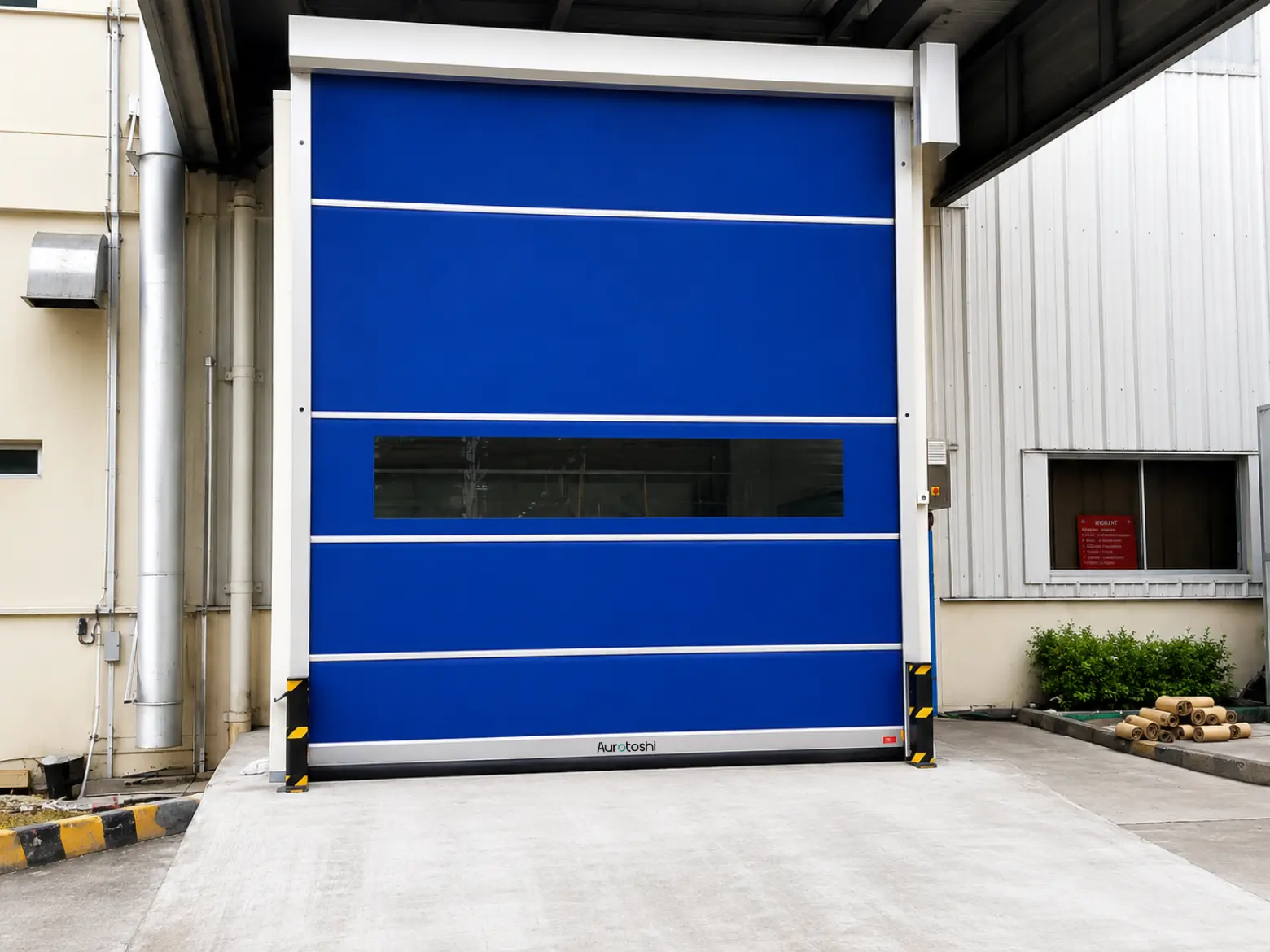
A high speed door is a rapid-opening industrial door, typically using a flexible curtain guided by side tracks and driven by a servo motor, engineered to open and close far faster than a standard rolling shutter or sectional door. The goal isn't just speed for its own sake. It's minimising the time an opening stays exposed, which directly affects energy loss, contamination risk, and how much a facility's traffic flow gets held up at each doorway.
Where a standard rolling shutter is built for security and general access control, a high speed door is built for facilities where the opening cycles constantly, sometimes thousands of times a day, and every extra second of open time has a real operational cost.
Types of High Speed Doors
1. Roll-Up High Speed Doors
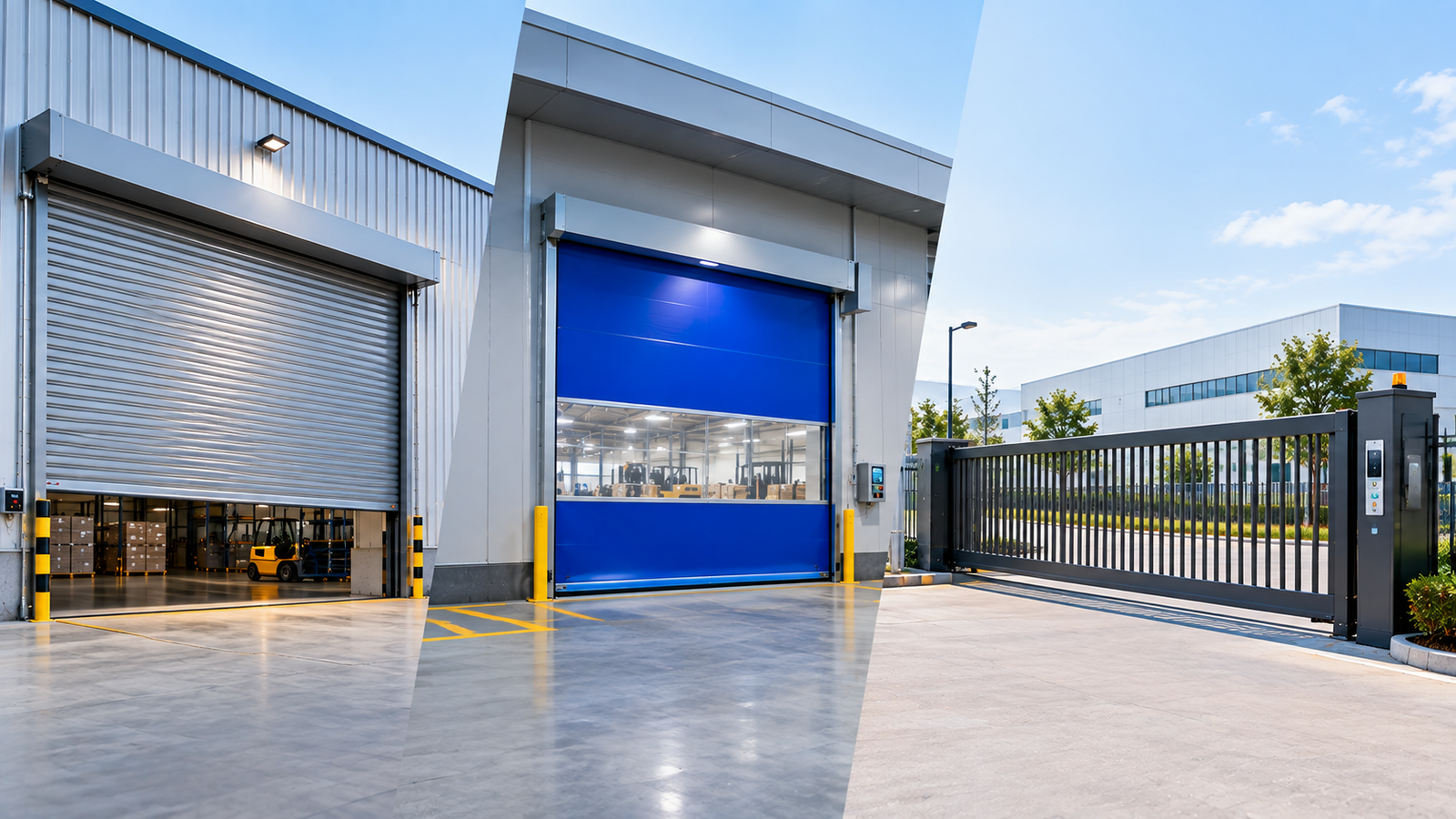
The workhorse variant for fast, high-traffic internal and external openings. The Supreme Roll-Up model opens at up to 2 metres per second, is rated for 2,000 cycles a day, and covers openings up to 5,000 mm wide and 6,000 mm high. It runs on an AC servo motor with an absolute encoder, has a galvanized steel frame as standard, and is wind-rated up to 100 kmph. This is the default choice for warehouse loading bays, internal separation between zones, and any high-frequency opening where speed and running cost both matter.
2. Self-Repairable Zipper High Speed Doors
Purpose-built for cleanrooms, pharma facilities, and air-lock separation where a tight hygienic seal matters as much as speed. It also opens at up to 2 metres per second and handles the same 2,000 cycles a day as the roll-up variant, though the opening size is smaller, up to 4,000 mm by 4,000 mm. The defining feature is self-repair: if a forklift or vehicle impacts the curtain, it re-zips itself automatically with zero downtime, instead of requiring a service call. Frame options include galvanized steel or SS 304 for hygienic, wash-down environments.
3. Fold-Up High Speed Doors
Built for the largest, most wind-exposed exterior openings, up to 10,000 mm wide and 12,000 mm high, and rated to withstand wind loads up to 150 kmph, the highest of the three variants. Speed is lower, up to 0.5 metres per second, and duty cycle is rated for 250 cycles a day rather than 2,000, reflecting its role: occasional large-vehicle or aircraft-hangar-scale access rather than constant high-frequency traffic.
Comparing the Three Types
A side-by-side view of how the three variants differ on the specifications that actually matter for facility planning:
|
Specification |
Roll-Up |
Self-Repairing Zipper |
Fold-Up |
|
Best For |
Fast, high-traffic internal openings |
Cleanrooms and air-lock separation |
Large, wind-exposed exterior openings |
|
Speed |
Up to 2 m/sec |
Up to 2 m/sec |
Up to 0.5 m/sec |
|
Traffic Handled |
2,000 cycles/day |
2,000 cycles/day |
250 cycles/day |
|
Max Opening Size |
5,000 x 6,000 mm |
4,000 x 4,000 mm |
10,000 x 12,000 mm |
|
Wind Resistance |
Up to 100 kmph |
Up to 80 kmph |
Up to 150 kmph |
|
Auto-Reinsert on Impact |
No |
Yes, zero downtime |
No |
|
Frame Options |
Galvanized steel |
Galvanized steel or SS 304 |
Galvanized steel |
|
EN 13241-1 Compliant |
Yes |
Yes |
Yes |
Built for Continuous Duty: The Numbers That Matter
A high speed door is only as good as its ability to keep operating under real, repeated industrial use. These are the specifications worth checking, from any manufacturer, before installation, not after breakdowns start:
• Opening Speed: up to 2 m/sec on roll-up and zipper variants, the main factor in how much conditioned air or contamination exposure each cycle actually costs
• Duty Cycle: up to 2,000 cycles per day on high-traffic variants, built for constant forklift and pedestrian movement rather than occasional use
• MTBF: 500,000-cycle mean time between failures, CE-certified and standardized for long-term reliability
• Operator Protection: IP 54 rated, protecting the motor and control electronics from dust and moisture in industrial environments
• Curtain: reinforced PVC-coated polyester fabric, UV-treated and anti-microbial to resist wear, weather, and contamination
• Standards Compliance: EN 13241-1 for the door itself, EN 12453 for safety in use, and EN 12978 for safety devices
A door that can't document these numbers likely wasn't engineered for continuous industrial duty, and that shows up as breakdown frequency within the first year, not on the spec sheet at the time of purchase.
Safety Features to Look For
High speed doors operate at speed, in traffic areas, which makes safety configuration a real specification decision, not an afterthought. Look for doors offering:
• Photocell sensors to detect people or objects in the door's path
• Light curtains for continuous protection across the full opening width
• Airbag sensors on the bottom edge to prevent impact injury
• Vision panels so operators and pedestrians can see through the curtain before it fully opens
• Servo motor with encoder-set travel limits and fault-code detection on the control panel, so issues are flagged before they cause a full breakdown
How to Choose the Right High Speed Door
1. Match the Variant to Your Opening Size and Traffic
High-frequency internal or external openings under 5,000 x 6,000 mm are well served by a roll-up door. Larger, less frequently used exterior openings, especially wind-exposed ones, need the fold-up variant instead.
2. Check Whether Hygiene Compliance Applies
Pharma, food processing, and semiconductor facilities generally require the self-repairing zipper variant, particularly where SS 304 framing and a tight hygienic seal are part of the facility's compliance requirements, not just a preference.
3. Factor In Wind Exposure
External openings need a wind load rating matched to the site. The fold-up variant's 150 kmph rating is built specifically for the most exposed installations, while roll-up and zipper doors, rated to 100 kmph and 80 kmph respectively, suit less exposed or more sheltered openings.
4. Prioritise Duty Cycle Over Sticker Price
A door quoted without a documented cycles-per-day rating is a door that hasn't been engineered for your actual traffic volume. Paying less upfront for a door rated at a few hundred cycles a day, then running it at warehouse-level traffic, is what leads to early motor and curtain failure.
5. Confirm Safety Device Compatibility
Facilities with mixed forklift and pedestrian traffic need photocell, light curtain, and airbag protection as standard, not optional add-ons quoted separately after the fact.
6. Verify Manufacturer Standards and Local Support
EN 13241-1, EN 12453, and EN 12978 compliance should be documented, not just claimed. Combine that with a manufacturer offering structured AMC and locally available spare parts in India, so a curtain or motor issue doesn't turn into weeks of downtime waiting on an import.
Applications Across Industries
High speed doors are used wherever facilities need fast, repeated access without compromising environmental or contamination control:
• Warehousing and logistics: high-frequency internal separations and loading-bay entrances functioning as an automatic gate for warehouse traffic
• Automobile manufacturing: rapid movement between production zones without slowing the line
• Food and beverage facilities: contamination control between processing and packing areas
• Pharmaceutical and semiconductor facilities: cleanroom air-locks requiring hygienic, self-repairing zipper doors
• Cold storage: minimising temperature loss on every open and close cycle
Aurotoshi (An Aurionpro Group Company) supplies High Speed Doors across all of these environments, backed by EN 13241-1, EN 12453, and EN 12978 compliance, and 24/7 AMC support with spare parts dispatched from our Ghaziabad facility, not imported on a delay.
Conclusion
High speed doors aren't a single product with a single spec sheet. The right variant depends on your opening size, daily traffic volume, wind exposure, and whether hygiene compliance applies. Getting this choice right upfront, based on documented duty cycles, speed ratings, and certification rather than a generic sales pitch, is what determines whether the door becomes a reliable part of daily operations or a recurring maintenance problem within the first year.
Aurotoshi is a Make in India High Speed Door Manufacturer offering roll-up, self-repairing zipper, and fold-up variants, all CE-certified and built to EN 13241-1, EN 12453, and EN 12978 standards, with duty cycles up to 2,000 per day and a 500,000-cycle MTBF.
Looking for a Reliable High Speed Door Manufacturer India?
Aurotoshi (An Aurionpro Group Company) manufactures a complete range of High Speed Doors, roll-up, self-repairing zipper, and fold-up, engineered for Indian operating conditions and backed by structured AMC support. Explore our full High Speed Doors range to see specifications, models, and case studies, or check our Rolling Shutters range if security and wind resistance are the priority instead. Get in touch for a quote tailored to your facility.
Contact Aurotoshi today to discuss your high speed door requirements.
Frequently Asked Questions
1. What is a high speed door and where is it used?
A high speed door is a rapid-opening industrial door designed to minimise air exchange and contamination while enabling fast movement of people, vehicles, and goods. It's commonly used in warehouses, cleanrooms, cold storage, food processing, and manufacturing facilities.
2. How fast do high speed doors operate?
Roll-up and self-repairing zipper high speed doors open at speeds up to 2 metres per second. Fold-up variants, built for larger and more wind-exposed openings, operate at up to 0.5 metres per second.
3. How many operating cycles can a high speed door handle daily?
High-traffic roll-up and zipper variants are rated for up to 2,000 cycles per day. Fold-up doors, built for occasional large-vehicle access rather than constant traffic, are rated for around 250 cycles per day.
4. What is a self-repairing high speed door?
A self-repairing (zipper) high speed door automatically re-zips its curtain if it's impacted by a forklift or vehicle, restoring the seal without downtime or a service call. It's commonly used in cleanrooms and pharma facilities.
5. Are high speed doors suitable for cleanrooms and pharma facilities?
Yes. Self-repairing zipper high speed doors are specifically designed for cleanroom and pharma use, with SS 304 frame options available for hygienic, wash-down environments and auto-reset operation to maintain air-lock separation.
6. What is the difference between a high speed door and a rolling shutter?
Rolling shutters are built primarily for security and general access control with higher wind load and cycle ratings, while high speed doors prioritise rapid opening and closing speed, up to 2 m/sec, for facilities where minimising open-air time matters more than structural security.
7. What wind load can high speed doors withstand?
It depends on the variant. Roll-up doors are rated up to 100 kmph, self-repairing zipper doors up to 80 kmph, and fold-up doors, built for the most exposed exterior openings, up to 150 kmph.
8. What is the maximum opening size for a high speed door?
Fold-up high speed doors cover the largest openings, up to 10,000 mm wide and 12,000 mm high, making them suitable for aircraft hangars and oversized industrial entrances. Roll-up doors cover up to 5,000 x 6,000 mm.
9. What curtain material is used in high speed doors?
Most high speed doors use a reinforced PVC-coated polyester curtain that's UV-treated and anti-microbial, built to resist wear, weather exposure, and contamination in industrial and hygienic environments.
10. How do I choose a reliable High Speed Door Manufacturer in India?
Check for EN 13241-1, EN 12453, and EN 12978 compliance, a documented duty cycle and MTBF rating, configurable safety devices such as photocells and light curtains, and a manufacturer offering structured AMC with locally available spare parts rather than import-dependent support.