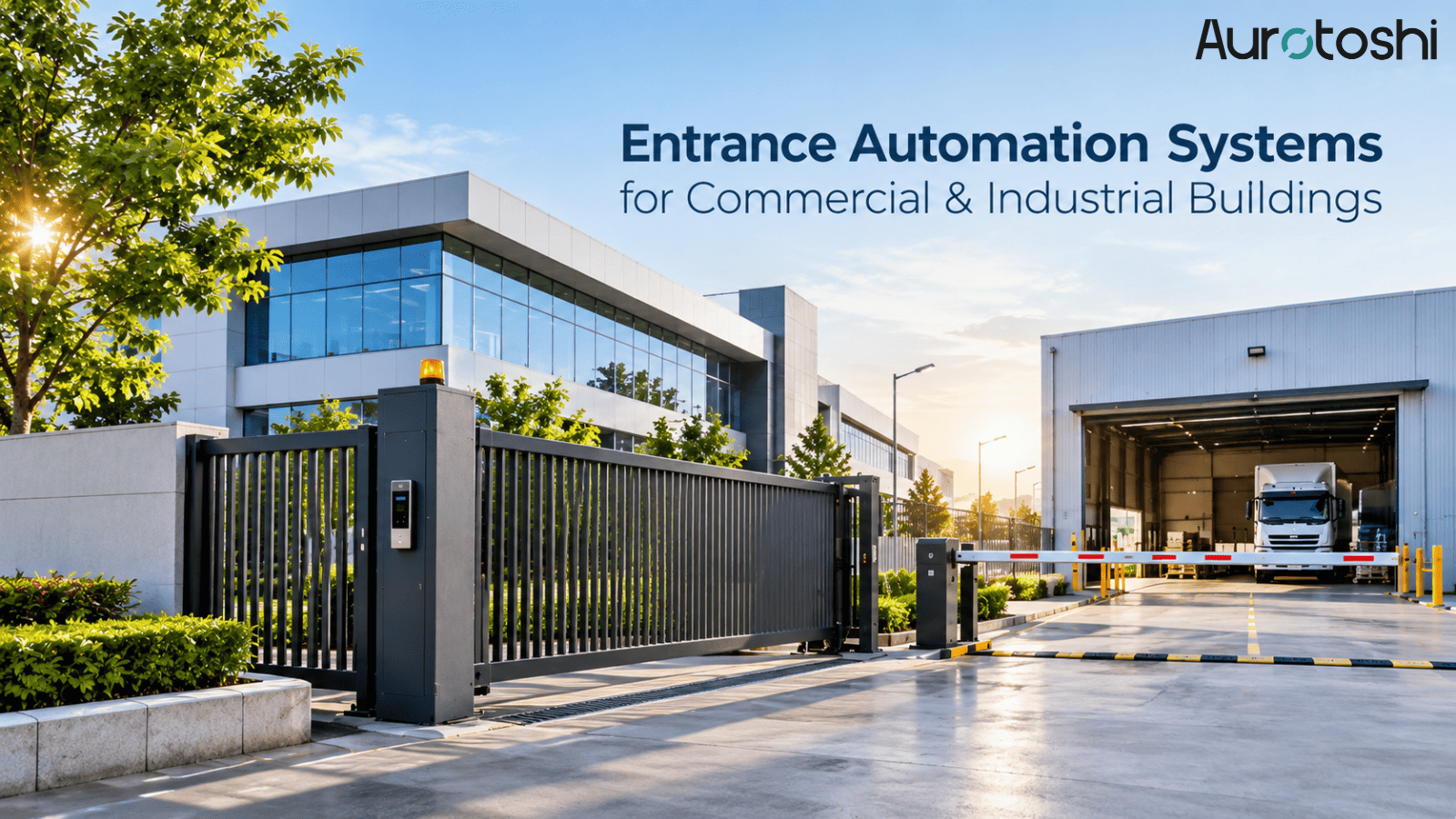
Entrance gates are an important part of security and traffic management at factories, warehouses, manufacturing plants, logistics parks, commercial buildings and large industrial facilities. Choosing the right Entrance Gate Manufacturer in India can help businesses get a gate system that is properly designed for their site, vehicle movement, security requirements and operating conditions. The right gate does more than control who enters and exits. It can help manage vehicle movement, improve site security, support access-control systems and keep busy entrances operating smoothly.
With different site layouts, opening widths, traffic volumes and security requirements, there is no single entrance gate that works for every facility. Sliding gates, telescopic gates, cantilever gates, swing gates and retractable gates each offer different advantages.
This guide explains the major types of entrance gates used in India, where they are suitable and what businesses should consider when selecting an entrance gate system.
What Is an Entrance Gate?
An entrance gate is a controlled access system installed at the entry or exit point of a property. It can be operated manually or automatically and may be integrated with access-control systems such as RFID readers, remote controls, vehicle identification systems, card readers and other security technologies.
For industrial and commercial facilities, automated entrance gates can provide controlled vehicle access while reducing the need for manual gate operation.
The most suitable configuration depends on factors such as the available space, opening width, vehicle movement, gate weight, operating frequency, ground conditions and required level of security.
Types of Entrance Gates Used in India
Different properties require different gate configurations. The most common types include:
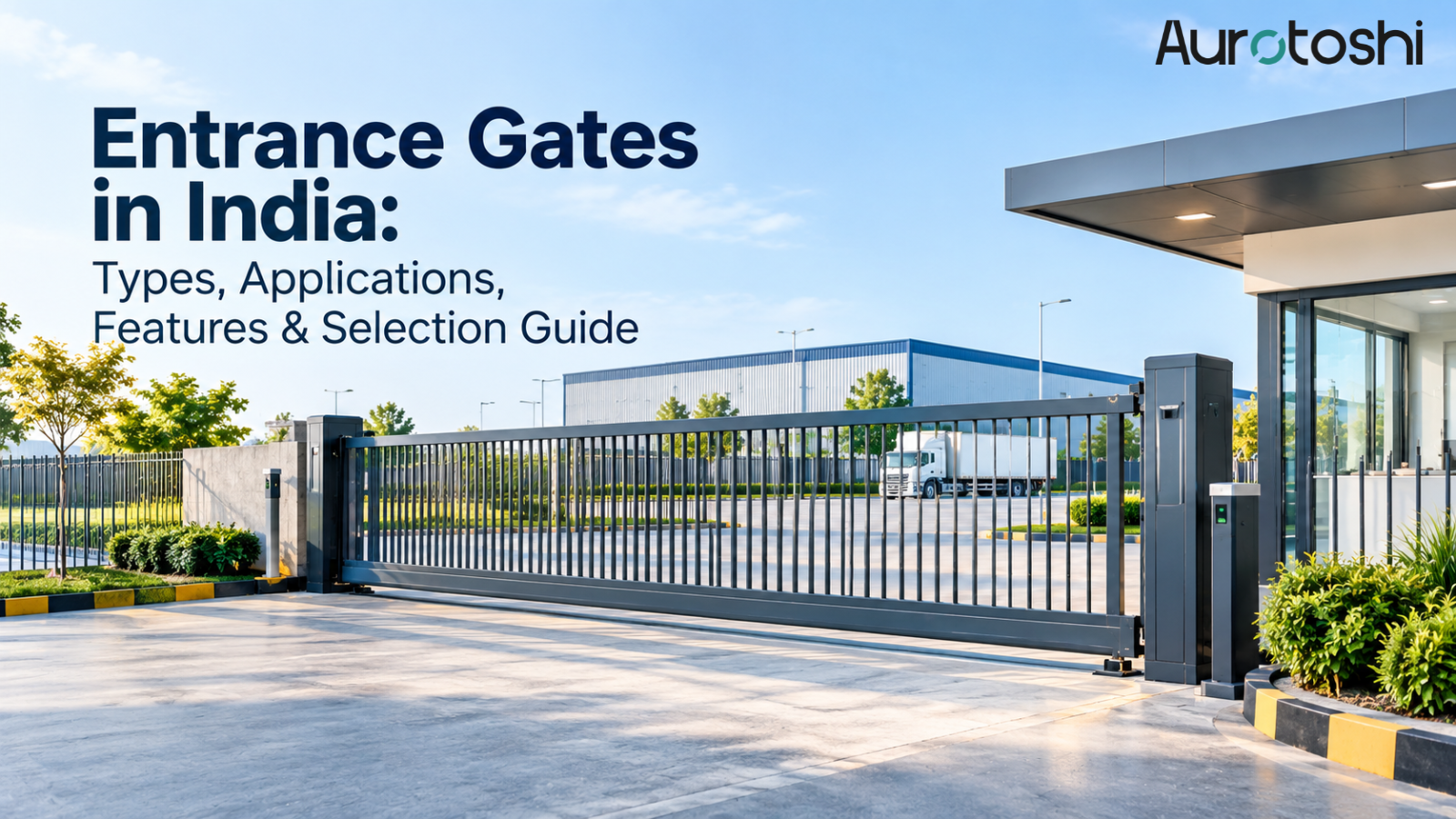
1. Automatic Sliding Gates
Sliding gates move horizontally along the entrance instead of swinging into the driveway. They are a practical option where sufficient side space is available for the gate to move.
Aurotoshi's sliding gate configuration is built to support gate weights from 500 kg up to 6,000 kg, with clear openings up to 50 metres for a single leaf, using a welded MS or SS leaf with galvanised wheels.
They are commonly used at:
• Manufacturing plants
• Warehouses
• Industrial estates
• Logistics facilities
• Commercial premises
• Large residential and institutional properties
Sliding gates are particularly useful for wide vehicle entrances where controlled and predictable movement is required.
2. Telescopic Sliding Gates
Telescopic gates use multiple gate sections that slide behind one another. This configuration reduces the side space required compared with a conventional sliding gate, and can cover openings up to 75 metres where a single sliding leaf would need more run-back space than the site has available.
They can be useful when a facility needs a wide opening but has limited run-back space.
Before selecting this configuration, the available side space, gate dimensions, operating frequency and structural conditions should be evaluated.
3. Cantilever Gates
A cantilever gate is supported from the side rather than running on a conventional ground track across the entrance. Aurotoshi's cantilever configuration supports gate weights from 500 kg up to 6,000 kg and clear openings up to 12 metres.
This makes it useful at sites where a ground track may be difficult to install or maintain because of uneven surfaces, debris, heavy vehicle movement or drainage requirements.
Cantilever gates are commonly considered for industrial and commercial entrances where reliability and uninterrupted vehicle movement are important.
4. Swing Gates
Swing gates operate by moving the gate leaf or leaves inward or outward around hinges. Aurotoshi's swing gate configuration supports gate weights from 300 kg up to 2,000 kg and clear openings up to 10 metres.
They can be suitable where there is adequate clearance around the entrance and where the site layout allows the gate to swing safely.
Swing gates are commonly used at commercial facilities, industrial premises, institutions and controlled-access properties.
5. Retractable Gates
Retractable gate configurations can be considered for wide openings or sites where conventional sliding arrangements may not provide the required coverage. Aurotoshi's retractable configuration supports openings up to 25 metres using a self-supporting fin assembly that retracts into the gate head, so wide openings can be secured without a long side run-back area.
They can be designed according to the available entrance width and operational requirements.
For large industrial entrances, the gate configuration should be selected after considering vehicle turning space, traffic flow, security requirements and available installation area.
Where Are Automatic Entrance Gates Used?
Entrance automation gates are used across a wide range of commercial and industrial environments.
Factories and Manufacturing Plants
Manufacturing facilities often have separate movements for employees, raw materials, finished goods, vendors and heavy vehicles. An automated entrance gate can help control vehicle access while maintaining an organised entry process. Aurotoshi's Samsung Electronics India project is one example of this, where motorized telescopic sliding gates were installed as part of a wider building-envelope solution for a high-volume manufacturing facility.
Warehouses and Distribution Centres
Warehouses may experience continuous movement of trucks, delivery vehicles and other commercial traffic. A suitable entrance gate can help manage access without unnecessarily slowing down vehicle movement.
Logistics Parks
Logistics facilities generally require efficient vehicle movement because several vehicles may enter and exit throughout the day. Gate selection should therefore consider traffic frequency, opening width and integration with access-control systems.
Industrial Estates
Industrial estates may have large entrances with a mix of employee vehicles, commercial vehicles and visitors. Automated gates can provide a controlled access point while supporting site security.
Commercial and Institutional Buildings
Commercial campuses, offices, educational institutions and other large premises may use automatic entrance gates to control vehicle access and improve the overall entrance experience.
Benefits of Automatic Entrance Gates
Improved Vehicle Access Control
Automatic gates can help restrict entry to authorised vehicles and integrate with access-control systems.
Better Traffic Management
A properly designed entrance gate can help organise incoming and outgoing vehicle movement, particularly at facilities with regular commercial traffic.
Reduced Manual Operation
Automation reduces dependence on personnel for opening and closing the gate each time a vehicle arrives.
Integration With Security Systems
Depending on the installation, entrance gates can be integrated with access-control and identification systems to create a more coordinated security arrangement.
Suitable for High-Traffic Entrances
Industrial facilities with frequent vehicle movement can benefit from automated operation when the gate is correctly specified for the operating conditions.
Flexible Gate Configurations
Different gate types allow businesses to select a solution according to the available space, opening width, ground conditions and security requirements.
How to Choose the Right Entrance Gate
Selecting an entrance gate should start with the site rather than the gate model.
1. Check the Opening Width
The required clear opening is one of the first factors to determine. Large truck entrances may require a different configuration from pedestrian or passenger-vehicle entrances.
2. Consider Available Space
A sliding gate requires suitable side run-back, while a swing gate needs enough space for the gate leaf to operate.
Where space is restricted, telescopic or other configurations may be more appropriate.
3. Evaluate Vehicle Traffic
Consider how many vehicles use the entrance during a normal day and how frequently the gate needs to operate.
A gate intended for occasional use should not necessarily be specified in the same way as a gate operating continuously at a logistics facility.
4. Consider Ground Conditions
The entrance surface, drainage, slope, debris and existing civil structure can affect gate selection.
For example, a cantilever configuration may be considered where a conventional ground track is not suitable.
5. Look at Security Requirements
The required level of access control should be considered alongside the physical gate. Facilities may require integration with RFID, remote access, vehicle identification or other security systems.
6. Consider Safety Features
Automatic gates should be designed with appropriate safety systems to help reduce the risk of contact with vehicles, people or objects during operation.
The safety arrangement should be appropriate for the site, gate configuration and operating environment.
7. Consider Service and Maintenance
An entrance gate is a long-term operational asset. Businesses should consider the availability of installation support, spare parts, preventive maintenance and after-sales service before selecting a manufacturer.
Why Choosing the Right Entrance Gate Manufacturer Matters
The performance of an automatic entrance gate depends on more than the gate itself. Engineering, automation, installation and after-sales support all influence long-term performance.
An experienced Entrance Gate Manufacturer in India should be able to evaluate the opening, traffic pattern, gate size, operating frequency and site conditions before recommending a configuration.
Aurotoshi provides entrance gate solutions for industrial and commercial applications, including sliding, telescopic, cantilever, swing and retractable configurations, built to EN 13241-1 with CE-certified drive options. The company focuses on selecting the gate arrangement according to site layout, traffic requirements and security needs.
With more than 30 years of engineering experience, manufacturing capabilities and OEM and ODM expertise, Aurotoshi works on entrance automation solutions for different industrial and commercial requirements.
Entrance Gates and Access Control
An entrance gate can form one part of a broader access-control system.
Depending on the facility, the gate may work alongside:
• RFID access systems
• Remote controls
• Vehicle identification systems
• Security cabins
• CCTV systems
• Access-control software
• Safety sensors
• Other vehicle management systems
The objective is to create controlled vehicle movement without making the entrance unnecessarily difficult to operate.
Frequently Asked Questions
Which type of entrance gate is best for industrial facilities?
The best entrance gate depends on the opening width, available space, vehicle traffic, ground conditions and security requirements. Sliding, cantilever, telescopic and swing gates can all be suitable for industrial applications when correctly specified.
Which entrance gate is best for a wide opening?
The right configuration depends on the available side space and site layout. Sliding, telescopic, cantilever or retractable configurations may be considered for wide industrial entrances.
What is an automatic entrance gate?
An automatic entrance gate is a powered gate that opens and closes using an automated drive system. It can also be integrated with access-control systems to manage authorised vehicle entry and exit.
Can automatic entrance gates be integrated with access control?
Yes. Automatic entrance gates can be integrated with suitable access-control and identification systems depending on the site requirements and gate configuration.
Are automatic entrance gates suitable for factories and warehouses?
Yes. Automatic entrance gates are commonly used at factories, warehouses, logistics facilities and other industrial properties where controlled vehicle movement is required.
How do I choose an Entrance Gate Manufacturer in India?
Compare the manufacturer's engineering capabilities, gate configurations, automation options, installation support, service network, safety provisions and ability to customise the system according to your site requirements.
How much maintenance does an automatic entrance gate require?
Maintenance depends on the gate design, operating frequency, environmental conditions and automation system. Regular inspection and preventive maintenance can help identify mechanical, electrical and safety issues before they affect operation.
Conclusion
The right entrance gate should match the way a facility actually operates. Opening width, available space, vehicle traffic, ground conditions, security requirements and operating frequency all need to be considered before selecting a system.
For factories, warehouses, logistics parks and commercial facilities, working with an experienced Entrance Gate Manufacturer in India can help ensure that the gate is properly engineered, automated and installed for the site's requirements.
Aurotoshi offers multiple entrance gate configurations for industrial and commercial applications, with solutions designed around different site layouts and access requirements.