Industrial sites, corporate offices, warehouses and commercial complexes need access control systems that regulate entry without creating unnecessary delays or compromising security.
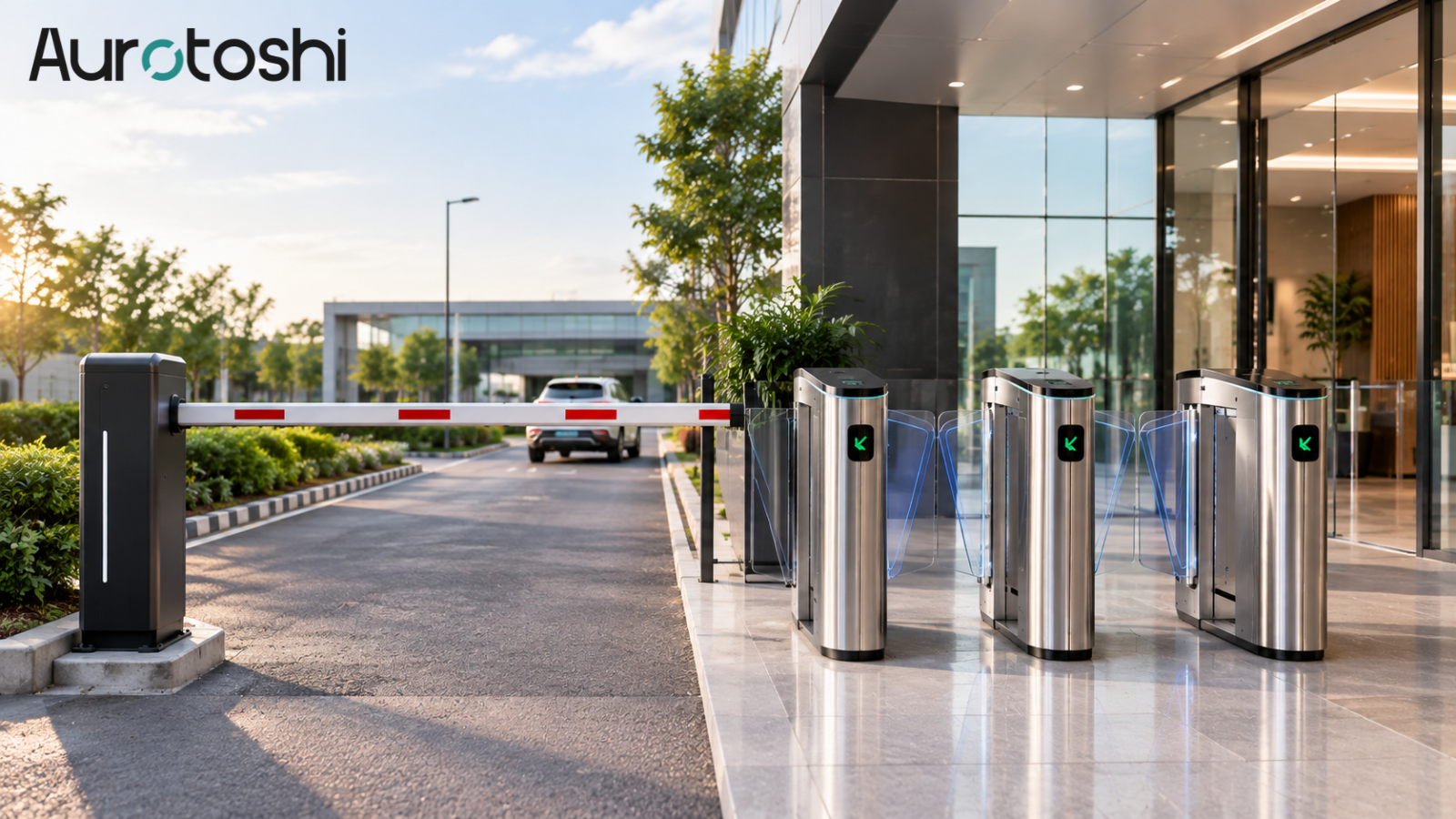
Boom barriers and flap barriers are two commonly used access control solutions, but they serve different purposes. A boom barrier manages vehicle movement at an entrance, while a flap barrier controls pedestrian access through a designated passage.
Understanding their differences helps facility managers, security consultants, procurement teams and project contractors choose equipment that matches their site's traffic, safety and operational requirements.
This guide explains how boom barriers and flap barriers work, where they are used, which features to compare and what to consider when selecting a suitable system.
What Is a Boom Barrier?
A boom barrier is an automated vehicle access control system that uses a motorised arm to regulate entry and exit. The arm rises to allow authorised vehicles to pass and lowers to restrict the lane after passage.
Boom barriers are commonly installed at parking facilities, corporate campuses, warehouses, factories, residential communities and industrial entrances. Depending on the configuration, they can integrate with RFID readers, QR-based ticketing systems, vehicle detectors and other access control equipment.
The right model depends on several factors, including vehicle traffic, lane width, opening and closing time, daily operating cycles, environmental conditions and safety requirements.
For example, a parking facility with moderate traffic may require a different system from an industrial site where vehicles enter and exit throughout the day. Wider lanes may also need longer boom arms and a drive mechanism suited to the operating conditions.
When comparing suppliers, businesses evaluating a Boom Barrier Manufacturer in India should consider the available boom lengths, rated operating cycles, safety devices, integration options, spare parts availability and after-sales support. These factors help determine whether the equipment is suitable for the intended application.
What Is a Flap Barrier?
A flap barrier is a pedestrian access control gate that uses retractable wings to regulate entry. The wings open when the system receives an authorised access signal and close after the person passes through the designated lane.
These barriers are suitable for corporate offices, IT parks, commercial buildings, educational institutions, industrial facilities and selected transit environments where controlled pedestrian movement is required.
Flap barriers can integrate with compatible RFID cards, QR codes, fingerprint readers, facial recognition systems and other access credentials. Infrared sensors monitor movement through the passage, while anti-tailgating and anti-pass-back functions help reduce unauthorised entry.
The selection process should consider pedestrian throughput, passage width, cabinet material, sensor configuration, drive mechanism, access control compatibility and emergency operating requirements.
For a facility with high employee footfall, the number of people passing through each lane per minute is particularly important. The installation should also accommodate accessibility requirements and comply with applicable building and fire safety provisions.
When shortlisting a Flap Barrier Manufacturer in India, buyers should compare these specifications alongside product reliability, integration capabilities, installation support and maintenance arrangements.
Boom Barrier vs Flap Barrier: Key Differences
The main difference between these systems is the type of movement they control. Beyond that, they differ in how capacity, safety and maintenance are measured, as the table below shows.
|
Comparison Factor |
Boom Barrier |
Flap Barrier |
|
Primary Purpose |
Vehicle access control |
Pedestrian access control |
|
Operating Mechanism |
Motorised arm |
Retractable wings |
|
Typical Locations |
Parking areas, warehouses, factories and vehicle entrances |
Office lobbies, campuses, industrial buildings and transit entrances |
|
Capacity Measurement |
Vehicles per hour and daily operating cycles |
Persons per minute per lane |
|
Access Control Options |
Compatible RFID, QR ticketing and vehicle detection systems |
Compatible RFID, QR and biometric credentials |
|
Key Dimensions |
Vehicle lane width and boom length |
Passage width and lane configuration |
|
Safety Considerations |
Photocells, vehicle detectors, obstacle protection and manual release |
Infrared sensors, anti-tailgating logic and emergency release |
|
Maintenance Requirements |
Drive mechanism, boom balance, controller and detection devices |
Drive assembly, wings, sensors and controller |
|
Main Selection Factors |
Traffic volume, lane span, duty cycle and site exposure |
Pedestrian throughput, passage width, credential integration and safety |
Neither system is universally better. The appropriate choice depends on the entrance layout, the type of users, expected traffic and the level of access control required.
How Does an Automatic Boom Barrier Work?
An automatic boom barrier operates through a motorised mechanism connected to a control unit. When an authorised access request is received, the controller activates the drive and raises the arm. The arm lowers according to the programmed operating sequence and the signals received from connected detection devices.
A typical installation includes the following components:
• Barrier arm and drive mechanism: Control vehicle passage across the lane.
• Control unit: Manages opening and closing commands.
• Access control interface: Connects with compatible RFID readers, QR ticketing systems or other authorisation devices.
• Safety and vehicle detection devices: Help detect vehicles or obstacles and reduce the risk of unsafe arm movement.
• Manual release mechanism: Allows manual operation during a power failure or equipment fault, according to the model's design.
The required configuration depends on the application. A high-traffic industrial entrance may need a heavy-duty barrier with a suitable duty rating, while a smaller parking facility may operate effectively with a system designed for moderate traffic.
Opening speed, boom length and daily cycle ratings should always be checked against the manufacturer's specifications before selecting a model.
How Does a Flap Barrier Work?
A flap barrier uses an access control interface, a drive mechanism, retractable wings and sensors to manage pedestrian passage.
The operating process generally involves these steps:
• A person presents an authorised credential, such as an access card or QR code.
• The connected access control system verifies the credential.
• The controller signals the barrier to retract its wings.
• Sensors monitor movement through the passage.
• The wings close after the authorised passage according to the configured operating logic.
Sensor coverage and controller programming are important for managing tailgating, where an unauthorised person attempts to follow an authorised user through the gate. Anti-pass-back functionality can also help enforce configured access rules.
However, these features do not guarantee that every unauthorised entry attempt will be prevented. Their effectiveness depends on the system configuration, user behaviour and overall security procedures.
Emergency operation also requires attention. The flap barrier should be integrated with the building's fire alarm and evacuation arrangements, and its release behaviour should be tested during commissioning.
Applications of Boom Barriers and Flap Barriers
1. Parking Facilities and Commercial Complexes
Boom barriers help regulate vehicle entry and exit at office parking areas, shopping complexes, residential communities and paid parking facilities. Integration with compatible RFID or QR-based ticketing can streamline vehicle access.
Flap barriers can be installed separately at building entrances to control pedestrian access to offices, restricted areas or staff-only zones.
2. Warehouses and Industrial Facilities
Factories and logistics centres often need to manage trucks, employee vehicles, contractors and visitors. Boom barriers can control designated vehicle lanes at the site perimeter or security gate.
Flap barriers can regulate pedestrian entry at staff access points, administrative buildings and restricted production areas.
3. Corporate Offices and Technology Parks
Flap barriers are suitable for office buildings with high employee footfall, particularly during arrival times and shift changes. Integration with compatible employee access cards or biometric systems can simplify authorised entry.
Boom barriers can manage vehicle access to basement parking, visitor parking and restricted service entrances.
4. Educational Institutions and Commercial Buildings
Boom barriers can regulate vehicle movement at campus entrances and parking areas. Flap barriers may be appropriate for selected buildings or restricted zones where controlled pedestrian entry is necessary.
The configuration should reflect visitor management procedures, accessibility needs, emergency routes and daily traffic patterns.
5. Transit and High-Footfall Environments
Flap barriers can help manage pedestrian movement at selected entrances. However, a conventional access control flap barrier is not automatically a replacement for an automatic fare collection (AFC) gate.
Transit applications involving ticket validation, fare calculation and journey reconciliation may require a dedicated AFC system. Boom barriers can serve separate vehicle access points used by authorised staff or service vehicles.
Can Boom Barriers and Flap Barriers Work Together?
Yes. A facility can use both systems as part of a coordinated physical security arrangement.
Consider an industrial campus with a vehicle entrance, employee parking area and main office building. A boom barrier can regulate vehicles at the site gate, while flap barriers control employee and visitor entry into the building.
Both systems may connect to a broader access management platform, depending on controller compatibility, communication protocols and integration requirements. However, each system must be selected according to its own operating conditions.
Using both systems can help establish separate access rules for vehicles and pedestrians, improve entry monitoring and create a more organised security process.
What Should You Check Before Choosing an Access Control Barrier?
Selecting an access control system involves more than comparing the initial purchase price. The equipment must match the site's conditions, expected usage and maintenance requirements.
1. Application and Traffic Volume
Estimate the number of vehicles or pedestrians using the entrance during peak periods. For boom barriers, consider daily cycles, peak-hour vehicle movement and queue formation. For flap barriers, evaluate persons per minute per lane and the number of lanes required.
2. Operating Duty and Service Life
Check the rated duty cycle, daily operating recommendations and mechanical life specifications. These measurements are not interchangeable, and actual suitability depends on usage patterns and operating conditions.
3. Dimensions and Site Layout
For boom barriers, measure the clear vehicle lane and assess the required boom reach, mounting space and exposure to wind.
For flap barriers, confirm the passage width, cabinet layout, accessibility requirements and available space for safe pedestrian movement.
4. Safety and Emergency Operation
Review the safety devices and operating modes offered with the selected model. Vehicle barriers may require suitable photocells, vehicle detectors and obstacle protection. Pedestrian barriers need appropriate sensor coverage, anti-tailgating logic and emergency release arrangements.
The final configuration should meet applicable standards and site-specific safety requirements.
5. Access Control Integration
Confirm compatibility with the existing access control platform, readers, ticketing equipment and building management infrastructure. Not every reader or software platform is compatible with every barrier, so integration requirements should be verified before purchase.
6. Manufacturing Capability and Technical Support
Review product documentation, commissioning arrangements, spare parts availability and maintenance support. For customised projects, check whether the supplier can accommodate the required hardware interfaces and control logic.
7. Total Cost of Ownership
Compare the purchase price with installation, integration, maintenance, replacement parts and expected operating life. A lower initial price may not offer the best value if the equipment is unsuitable for the traffic volume or operating environment.
Aurotoshi Boom Barrier and Flap Barrier Solutions
Aurotoshi offers both boom barrier and flap barrier ranges.
Aurotoshi (An Aurionpro Group Company) brings 30+ years of manufacturing experience, three manufacturing units and OEM/ODM capabilities to these ranges.
Its boom barrier range includes RIB, Italy models for applications with demanding duty requirements and the India-built PB001 for parking facilities, warehouses and corporate entrances.
Depending on the model, the range includes boom lengths of up to 7 metres, different operating duty ratings and options for compatible access control integration. The PB001 supports boom lengths of up to 6 metres, with an 80% duty cycle and opening times of approximately 4 to 5 seconds.
Aurotoshi's flap barrier range includes the FB242 Economy, FB203 Premium and FB221 Luxe models. Available features include retractable acrylic wings, stainless steel cabinet options and support for compatible access credentials. Published specifications include standard passage widths of 550 mm and a 900 mm option on the FB242.
The appropriate model depends on site traffic, operating requirements, layout, integration needs and budget. Specifications should be confirmed against the selected configuration before ordering.
For projects requiring a broader combination of vehicle and pedestrian access solutions, Aurotoshi also provides entrance automation systems for industrial and commercial applications. Discussing the site layout and operating requirements with the technical team can help identify a suitable configuration.
Frequently Asked Questions
1. What is the difference between a boom barrier and a flap barrier?
A boom barrier controls vehicle entry using a motorised arm that rises and lowers across a lane. A flap barrier controls pedestrian entry using retractable wings that open for authorised users. The choice depends on whether the entrance is intended for vehicles or people.
2. Where are automatic boom barriers commonly used?
Automatic boom barriers are commonly installed at parking facilities, office complexes, factories, warehouses, residential communities and industrial entrances. They help regulate vehicle movement and can integrate with compatible access control or parking management systems.
3. Where are flap barriers used?
Flap barriers are used at corporate offices, IT parks, commercial buildings, industrial facilities, educational institutions and selected transit entrances. They are useful where authorised pedestrian access and efficient movement through controlled lanes are required.
4. How do I choose a boom barrier for an industrial facility?
Consider vehicle lane width, daily operating cycles, peak traffic, opening time, environmental exposure, safety devices and access control requirements. Heavy-duty or extra-heavy-duty models may suit demanding applications, subject to the manufacturer's specifications and site assessment.
5. How many people can pass through a flap barrier per minute?
Throughput depends on the model, credential verification time, passage configuration and user behaviour. Aurotoshi specifies a rated throughput of 30 to 35 persons per minute per lane for its flap barrier range. Actual performance may vary with the installation and operating conditions.
6. Can boom barriers and flap barriers connect to an access control system?
Yes. Both can interface with compatible access control equipment. Boom barriers may connect with RFID readers, QR ticketing and vehicle detection systems, while flap barriers can support compatible RFID, QR and biometric credentials. Compatibility should be confirmed before installation.
7. Do flap barriers prevent tailgating?
Flap barriers can help detect and discourage tailgating through infrared sensors and access control logic. Effectiveness depends on sensor arrangement, controller configuration, user behaviour and security procedures. No single barrier guarantees protection against every unauthorised entry attempt.
8. What safety features should an automatic boom barrier have?
Depending on the application, useful safety provisions include photocells, vehicle loop detectors, obstacle detection, appropriate boom balancing and a manual release mechanism. The final arrangement should suit the selected model, site conditions and applicable safety requirements.
9. How much does an automatic boom barrier or flap barrier cost in India?
The cost depends on the model, dimensions, operating duty, materials, access control integration, installation conditions and service requirements. Heavy-duty systems and customised installations may require additional equipment. Request a quotation based on the site layout and technical specifications for an accurate estimate.
10. How do I select a reliable access control barrier manufacturer in India?
Evaluate the manufacturer's technical documentation, product specifications, relevant certifications, manufacturing or supply capability, integration support, spare parts availability, installation services and maintenance arrangements. Compare the proposed equipment against your site requirements rather than selecting on price alone.
Conclusion
Boom barriers and flap barriers solve different access control challenges, so the right choice starts with who or what uses the entrance. Choosing the right system requires an understanding of traffic volume, site layout, operating duty, safety requirements and integration needs.
For industrial facilities, offices, warehouses and commercial buildings, the most suitable solution is one that matches the actual entrance requirements and remains maintainable throughout its operating life. Reviewing technical specifications and conducting a site assessment can help ensure that the selected equipment meets operational and security objectives.
Aurotoshi provides access control and entrance automation solutions for industrial and commercial applications. Businesses planning a new installation or facility upgrade can discuss their project requirements with the technical team.